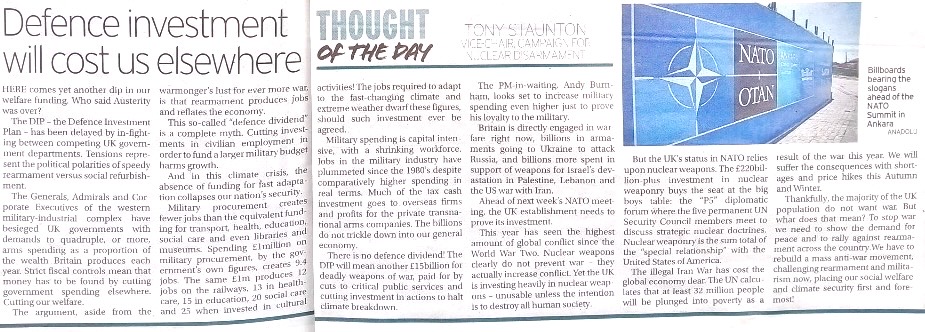
My weekly Comment Column in the daily Plymouth Herald (30.06.26), having to address the mythology and lies of the government’s Defence Implementation Plan published the same day. It’s a huge document offered and fast military rearmament and the effective militarisation of society. I focus on the government lie in suggesting a doubling of military spending can relate the economy. Whilst not wanting to rely on outdated (to the point of equally mythological) Keynesianism, the very fact, across all sectors, finance investment in any sector other than armaments and soldiery creates and sustains more jobs, is a single point that demolishes the entire document. There is, of course, far more to say, such as the capitalist crisis driving war. But I’m simply answering the government foil of a headline. War doesn’t produce growth!
The unedited version below, or stretch the pic of the published article to read:
Here comes yet another dip in our welfare funding. Who said Austerity was over?
The DIP – the Defence Investment Plan, published this week – has been delayed by in-fighting between competing UK government departments and the heads of the armed forces. Tensions represent the politics of speedy rearmament versus social refurbishment.
The Generals, Admirals and Corporate Executives of the western military-industrial complex have besieged UK governments with demands to quadruple, or more, arms spending as a proportion of the wealth Britain produces each year. Strict fiscal controls mean that money has to be found by cutting government spending elsewhere. Cutting our Welfare.
The argument, aside from warmonger’s thrust for ever more war, is that rearmament produces jobs and reflates the economy. This so-called “defence Dividend” is a complete myth. Cutting investments in civilian employment in order to fund a larger military budget harms growth. And in this climate crisis, the absence of funding for fast adaptation collapses our nations security.
Military procurement creates fewer jobs than the equivalent funding for transport, health, education, social care and even libraries and museums (congrats to The Box btw!). Spending £1million on military procurement, by government’s own figures, creates 9.4 jobs. The same £1m produces 12 jobs on the railways, 13 in healthcare, 15 in education, 20 in social care and 25 when invested in cultural activities! The jobs required to adapt to new climate and extreme weather dwarf these figures, if the investment should ever be agreed.
Military spending is capital intensive, with a shrinking workforce. Jobs in the military industry have plummeted since the 1980’s despite comparatively higher spending in real terms. Much of the tax cash investment goes to overseas firms and profits for the private arms companies. The billions do not trickle down into the general economy.
There is no defence dividend! Today’s DIP will mean another £15 billion for deadly weapons of war, paid for by cuts to critical public services and investment in action to halt climate breakdown. The new Prime Minister Burnham looks set to increase military spending even higher.
Why? In part it’s the political ideology of nationalism. Some bizarre drive to “Restore Britain” as the colonial military Empire of the 19th Century. Britain is directly engaged in warfare right now, billions in armaments going to Ukraine to attack Russia, and billions more spent in support of weapons for Israel’s devastation of Palestine, Lebanon and the US war with Iran.
Ahead of next week’s NATO meeting, the UK Establishment want to show its power. There is competition for such rearmament across a fast-militarising Europe. Germany wants to be the primary military power in Europe. The US F35 jets delivered to France represent more power and influence to the French. The German rearmament is very serious, reflecting a far-Right section of the ruling class actively wanting military conflict with Russia – even arguing for the “righting the wrongs” of the outcome of the Second World War.
2026 has seen the highest amount of global conflict since the Second World War. Nuclear weapons clearly do not prevent war – they actually increase conflict. Yet the UK is investing heavily in nuclear weapons – unusable unless the intention is to destroy all human society.
Truth is, the UK’s status in NATO relies upon nuclear weapons. The value is not in weaponry but in a seat at the big boys table: the P5 dedicated diplomatic forum where the five permanent UN Security Council members meet to discuss strategic stability and nuclear doctrines. UK consequently also sits on the NATO Nuclear Planning Group (NPG), dependent upon State alignment with US military policy. Nuclear War is the sum total of the “special relationship” with the United States of America.
The illegal Iran War has cost the global economy dear. The UN calculates that at least 32million people will be plunged into poverty as a result of the war, largely through its impact on energy and fertiliser supplies. We will suffer the consequences of shortages and price hikes this Autumn and Winter.
Thankfully, the majority of the UK population do not want a war. But what does that mean? To stop war we need a show of demand for peace and against rearmament across the country.
It is clear that the warmongers are in power. We have to build a mass anti-war movement, challenging rearmament and militarism now, and placing our social welfare and climate security first and foremost!