Defence Investment Will Cost Us Elsewhere

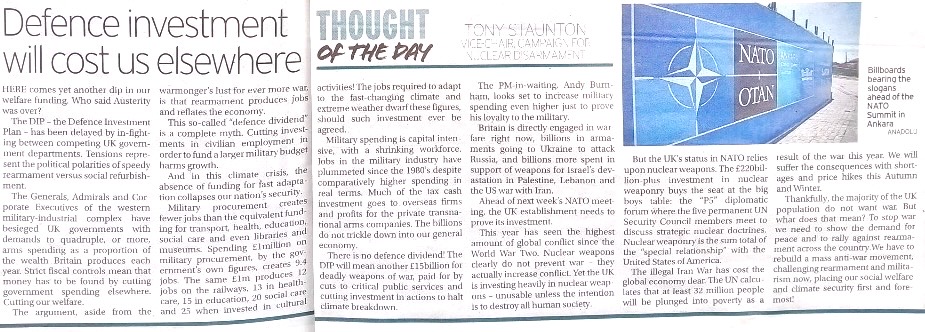
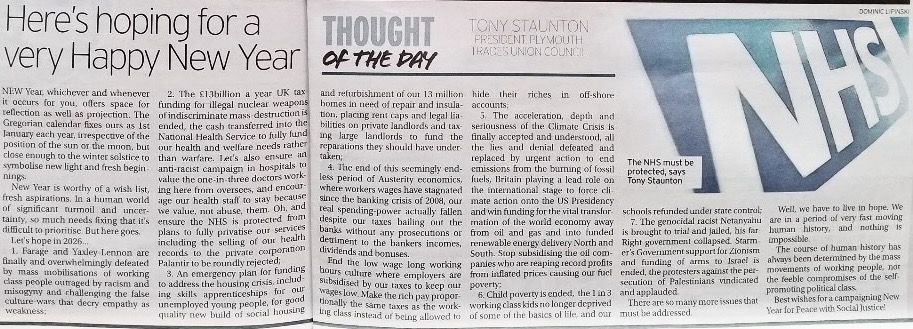
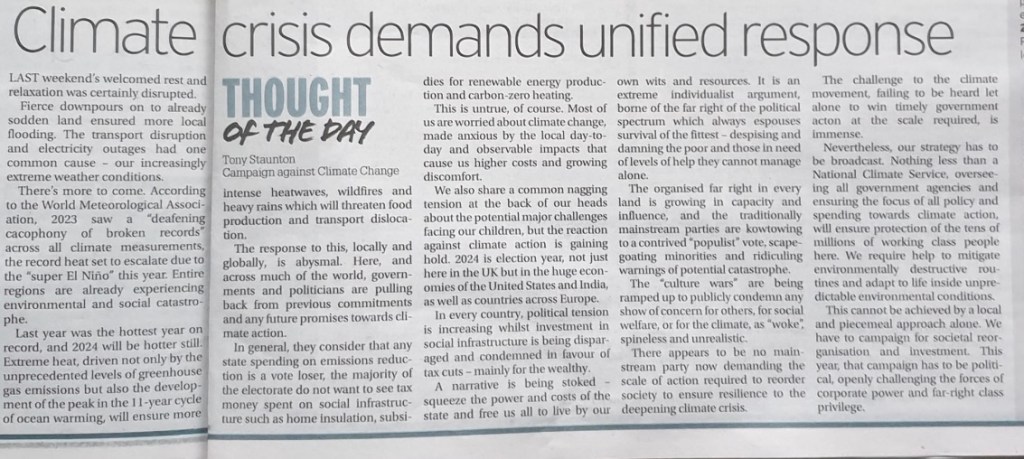
The unedited version below, or stretch the pic of the published article to read:

Here comes yet another dip in our welfare funding. Who said Austerity was over?

The DIP – the Defence Investment Plan, published this week – has been delayed by in-fighting between competing UK government departments and the heads of the armed forces. Tensions represent the politics of speedy rearmament versus social refurbishment. 

The Generals, Admirals and Corporate Executives of the western military-industrial complex have besieged UK governments with demands to quadruple, or more, arms spending as a proportion of the wealth Britain produces each year. Strict fiscal controls mean that money has to be found by cutting government spending elsewhere. Cutting our Welfare.

The argument, aside from warmonger’s thrust for ever more war, is that rearmament produces jobs and reflates the economy. This so-called “defence Dividend” is a complete myth. Cutting investments in civilian employment in order to fund a larger military budget harms growth. And in this climate crisis, the absence of funding for fast adaptation collapses our nations security.

Military procurement creates fewer jobs than the equivalent funding for transport, health, education, social care and even libraries and museums (congrats to The Box btw!). Spending £1million on military procurement, by government’s own figures, creates 9.4 jobs. The same £1m produces 12 jobs on the railways, 13 in healthcare, 15 in education, 20 in social care and 25 when invested in cultural activities! The jobs required to adapt to new climate and extreme weather dwarf these figures, if the investment should ever be agreed.

Military spending is capital intensive, with a shrinking workforce. Jobs in the military industry have plummeted since the 1980’s despite comparatively higher spending in real terms. Much of the tax cash investment goes to overseas firms and profits for the private arms companies. The billions do not trickle down into the general economy.

There is no defence dividend! Today’s DIP will mean another £15 billion for deadly weapons of war, paid for by cuts to critical public services and investment in action to halt climate breakdown. The new Prime Minister Burnham looks set to increase military spending even higher.

Why? In part it’s the political ideology of nationalism. Some bizarre drive to “Restore Britain” as the colonial military Empire of the 19th Century. Britain is directly engaged in warfare right now, billions in armaments going to Ukraine to attack Russia, and billions more spent in support of weapons for Israel’s devastation of Palestine, Lebanon and the US war with Iran. 

Ahead of next week’s NATO meeting, the UK Establishment want to show its power. There is competition for such rearmament across a fast-militarising Europe. Germany wants to be the primary military power in Europe. The US F35 jets delivered to France represent more power and influence to the French. The German rearmament is very serious, reflecting a far-Right section of the ruling class actively wanting military conflict with Russia – even arguing for the “righting the wrongs” of the outcome of the Second World War.

2026 has seen the highest amount of global conflict since the Second World War. Nuclear weapons clearly do not prevent war – they actually increase conflict. Yet the UK is investing heavily in nuclear weapons – unusable unless the intention is to destroy all human society. 

Truth is, the UK’s status in NATO relies upon nuclear weapons. The value is not in weaponry but in a seat at the big boys table: the P5 dedicated diplomatic forum where the five permanent UN Security Council members meet to discuss strategic stability and nuclear doctrines. UK consequently also sits on the NATO Nuclear Planning Group (NPG), dependent upon State alignment with US military policy. Nuclear War is the sum total of the “special relationship” with the United States of America.

The illegal Iran War has cost the global economy dear. The UN calculates that at least 32million people will be plunged into poverty as a result of the war, largely through its impact on energy and fertiliser supplies. We will suffer the consequences of shortages and price hikes this Autumn and Winter. 

Thankfully, the majority of the UK population do not want a war. But what does that mean? To stop war we need a show of demand for peace and against rearmament across the country.

It is clear that the warmongers are in power. We have to build a mass anti-war movement, challenging rearmament and militarism now, and placing our social welfare and climate security first and foremost!

Screenshot

Here’s Hoping for a Happy New Year!

Here’s hoping for a Happy New Year!

New Year, whichever and whenever it occurs for you, offers space for reflection as well as projection. The Gregorian calendar fixes ours as 1st January each year, irrespective of the position of the sun or the moon, but close enough to the winter solstice to symbolise new light and fresh beginnings.
New Year is worthy of a wish list, fresh aspirations. In a human world of significant turmoil and uncertainty, so much needs fixing that it’s difficult to prioritise. But here goes. Let’s hope in 2026:

  1. The fascist-led racist movements of Farage and Yaxley-Lennon are finally and overwhelmingly defeated by mass mobilisations of working class people outraged by racism and misogyny and challenging the false culture-wars that decry empathy as weakness;
  2. The £13billion a year UK tax-funding for illegal nuclear weapons of indiscriminate mass-destruction is ended, the cash transferred into the National Health Service to fully fund our health and welfare needs rather than warfare. Let’s also ensure an anti-racist campaign in hospitals to value the one-in-three doctors working here from oversees, and encourage our health staff to stay because we value, not abuse, them. Oh, and ensure the NHS is protected from plans to fully privatise our services – the selling of our health records to the private corporation Palantir to be roundly rejected;
  3. An emergency plan for funding to address the housing crisis, including skills apprenticeships for our unemployed young people, for good quality new build of social housing and refurbishment of our 13 million homes in need of repair and insulation, placing rent caps and legal liabilities on private landlords and taxing large landlords to fund the reparations they should have undertaken;
  4. The end of this seemingly endless period of Austerity economics, where workers wages have stagnated since the banking crisis of 2008, our real spending-power actually fallen despite our taxes bailing out the banks without any prosecutions or detriment to the bankers incomes, dividends and bonuses. End the low wage long working hours culture where employers are subsidised by our taxes to keep our wages low. Make the rich pay proportionally the same taxes as the working class instead of being allowed to hide their riches in off-shore accounts;
  5. The acceleration, depth and seriousness of the Climate Crisis is finally accepted and understood, all the lies and denial defeated and replaced by urgent action to end emissions from the burning of fossil fuels, Britain playing a lead role on the international stage to force climate action onto the US Presidency and win funding for the vital transformation of the world economy away from oil and gas and into funded renewable energy delivery North and South. Stop subsidising the oil companies who are reaping record profits from inflated prices causing our fuel poverty;
  6. Child poverty is ended, the 1 in 3 working class kids no longer deprived of some of the basics of life, and our schools refunded under state control;
  7. The genocidal racist Netanyahu is brought to trial and jailed, his far-Right government collapsed. Starmer’s Government support for Zionism and funding of arms to Israel is ended, the protesters against the persecution of Palestinians vindicated and applauded.
    There are so many more issues that must be addressed. Well, we have to live in hope. We are in a period of very fast moving human history, and nothing is impossible. The course of human history has always been determined by the mass movements of working people, not the feeble compromises of the self-promoting political class.
    Best wishes for a campaigning New Year for Peace with Social Justice!
Screenshot

The Climate Crisis Demands a Unified Response

Last weekend’s welcomed rest and relaxation was certainly disrupted. Fierce downpours onto already sodden land ensured more local flooding. The transport disruption and electricity outages had one common cause – our increasingly extreme weather conditions.

There’s more to come. According to the World Metereological Association, 2023 saw a “deafening cacophony of broken records” across all climate measurements, the record heat set to escalate due to the “super El Niño” this year. Entire regions are already experiencing environmental and social catastrophe.

Last  year was the hottest year on record, and 2024 will be hotter still. Extreme heat, driven not only by the unprecedented levels of greenhouse gas emissions but also the development of the peak in the eleven year cycle of ocean warming, will ensure more intense heatwaves, wildfires and heavy rains which will threaten food production and transport dislocation.

The response to this, locally and globally, is abysmal. Here, and across much of the world, governments and politicians are pulling back from previous commitments and any future promises towards climate action.

In general they consider that any State spending on emissions reduction is a vote loser, the majority of the electorate (not the same grouping as the majority of the population) do not want to see tax money spent on social infrastructure such as home insulation, subsidies for renewable energy production and carbon-zero heating. 

This is untrue, of course. Most of us are worried about climate change, made anxious not so much the big threats of species extinction and global climate collapse which we feel powerless to affect, but the local day-to-day and observable impacts that cause us higher costs and growing discomfort. 

We also share a common nagging tension at the back of our heads about the potential major challenges facing our children. 

But the reaction against climate action is gaining hold. 2024 is election year, not just here in the UK but in the huge economies of the United States and India as well as countries across Europe. 

In every country where political tension is increasing due to the continuing cost-of-living crisis, investment in social infrastructure is being disparaged and condemned in favour of tax cuts – mainly for the wealthy. 

A narrative is being stoked – squeeze the power and costs of the State and free us all to live by our own wits and resources. It is an extreme individualist argument, borne of the far-Right of the political spectrum which always espouses survival of the fittest – despising and damning the poor and those in need of levels of help they cannot manage alone. 

The organised far-Right in every land is growing in capacity and influence. And the traditionally mainstream parties are kowtowing to this contrived “populist” vote, scapegoating minorities and ridiculing warnings of potential catastrophe. 

The “culture wars” are being ramped-up to publicly condemn any show of concern for others, for social welfare, or for the climate, as “woke”, spineless and unrealistic. 

There appears to be no mainstream party now demanding the scale of action required to reorder society to ensure resilience to the deepening climate crisis. The challenge to the Climate Movement, failing to be heard let alone to win timely government acton at the scale required, is immense. 

Nevertheless, our strategy has to be broadcast. Nothing less than a National Climate Service, overseeing all government agencies and ensuring the focus of all policy and spending towards climate action, will ensure protection of the tens of millions of working class people here. We require help to mitigate environmentally destructive routines and adapt to life inside unpredictable environmental conditions. 

This cannot be achieved by a local and piecemeal approach alone. We have to campaign for societal reorganisation and investment. And this year, that campaign is distinctly ideological, openly challenging the forces of corporate power and far-Right class privilege.