
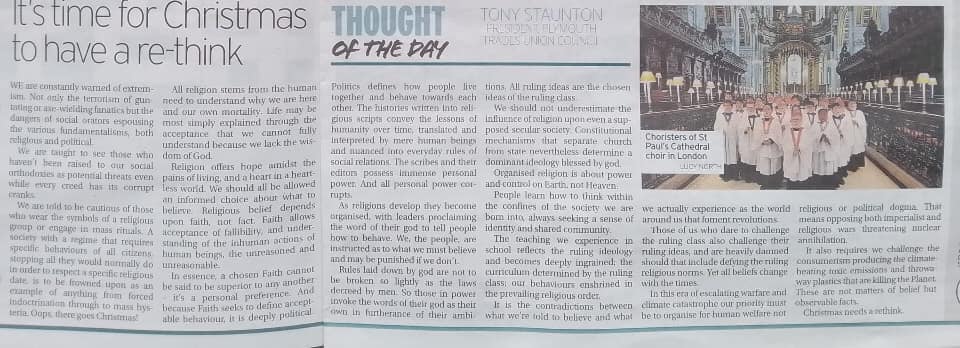
My weekly column in the daily Plymouth Herald (24.12.24) getting over-philosophical (it’s the time of year) and challenging all orthodoxies. No more Business as Usual (if we want to survive). Seasons Greetings, the unexpurgated version below:
We are constantly warned of extremism. Not only the terrorism of car-driving, gun-toting or axe-wielding fanatics but the social orators of various fundamentalisms, political as well as religious.
We are taught to see those who haven’t been raised to our orthodoxies as potential threats.
We are told to be cautious of those who wear the symbols and emblems of a religious group or engage in mass rituals. A society with a regime that requires specific behaviours of all citizens, stopping all they would normally do in order to respect a specific religious date, is to be frowned upon as an example of anything from forced indoctrination through to mass hysteria. Oops, there goes Christmas!
All religion stems from the primordial human need to understand why we are here as well as why we die. The apparent impossibility of answering those questions opens the door to an all-but infinite number of explanations. Events and situations that are unconscionable are explained by the wisdom of god or gods who do know that which we cannot know.
Religion offers hope amidst the pains of living, and a heart in a heartless world. Faith allows acceptance of fallibility, the inhuman actions of human beings, the unreasoned and unreasonable.
Because Faith seeks to define acceptable behaviour, it is deeply political. Politics is, after all, about how people live together and behave towards each other. And so, as religions develop and grow they become organised and led, by leaders, enrobed and ordained with the word of god, to tell people how to behave.
The histories written into religious scripts convey the lessons of humanity over time, but are nevertheless written down by human beings. Ancient scriptures are reinterpreted time and again, and subjected to the censorship or acceptance of those with the power to have them published or burnt. The stories and the rules are changed over time. Crude tenets are nuanced into everyday rules of social relations. The scribes and their editors possess immense personal power. And all personal power corrupts.
There are some material reasons for religious rules. In a world without fridges it was a good rule of thumb to not eat red meat riddled with disease. Should you be starving you may still be tempted to eat a pig or a cow, even if the King threatened you with punishment. But if it is god’s word, punishable with an after-life of eternal pain and damnation, you may rather starve to death in pursuit of life in the hereafter.
The rules laid down by god are not to be broken so lightly as the laws decreed by men. And so the church has power, political power. Most organised religion tells us we are born into a place in the social structure as ordained by god, and we should accept rather than challenge our rank in the class system. But the decrees laid down by the church change over time, determined by the prevailing social conditions. The religious edicts of a feudal society have to be turned-over as a new ruling class develops – the Capitalist mercantilists taking over political power from the landlords.
The ruling class power, its wealth and standing army, determines the rules of the church, not the other way round. Monasteries are burnt to the ground, bloody wars are waged between rival sects.
Catholic versus Protestant, Sunnis versus Shia, Hindu versus Buddhist…and within each there are challengers from the Left and the Right, doubters and zealots.
All religions involve battles for power. The power of ideas, accepted or rejected by those with the wealth and armies to enforce them. To a point where all ruling ideas are the chosen ideas of the ruling class.
It’s all about power and control on Earth, not Heaven.
People learn how to think within the confines of the society and natural world we are born into. The teaching we experience in school reflects the ruling ideology, the curriculum determined by the ruling class, the behaviours enshrined in the prevailing religious order. We try to behave and accept even when those ideas make little or no sense – do we starve or break the laws in order to survive?
It is the contradictions between what we’re told to believe and what we actually experience as the world around us that foment revolutions.
Those of us who dare to challenge the ruling class also challenge the ruling ideas, and are heavily damned should that include defying the ruling religious norms. We can be proclaimed as “ungodly”, a charge far worse than being “illegal”. Yet all beliefs change with the times.
And so there are times when the enforced religious rules no longer make sense and place the people in grave danger. They have to be defied, as does the ruling class who proclaims them. With an elite of billionaires ruling over mass poverty and requiring authoritarian compliance to the money-god, we are living in such times.
In this era of escalating warfare and climate catastrophe our priority must be to organise for human welfare not religious or political dogma. That means opposing both imperialist and religious wars threatening nuclear annihilation. It also requires we challenge the consumerism producing the climate-heating toxic emissions and throwaway plastics that are killing the Planet. These are not matters of belief but observable facts.
 Emotional Climate