

My weekly Comment column in the daily Plymouth Herald (21.10.25), asking the obvious, stirring-up dissent in this city dominated by the Navy and the Trident Nuclear dockyard.
The point is to raise the issues for the environmental movement here ahead of COP30. There is an acquiescence to new nuclear power which has to be challenged. With 600 words its impossible to deal with the arguments against both nuclear power and nuclear weapons together, but a longer article does. That’s why the published version is below, followed by the longer version if you have the time and commitment! No to Nuclear Power! Teachers not Trident! Nurses not Nukes! Welfare not Warfare! ☮️
Watch the movie – House of Dynamite – Netflix from Friday!
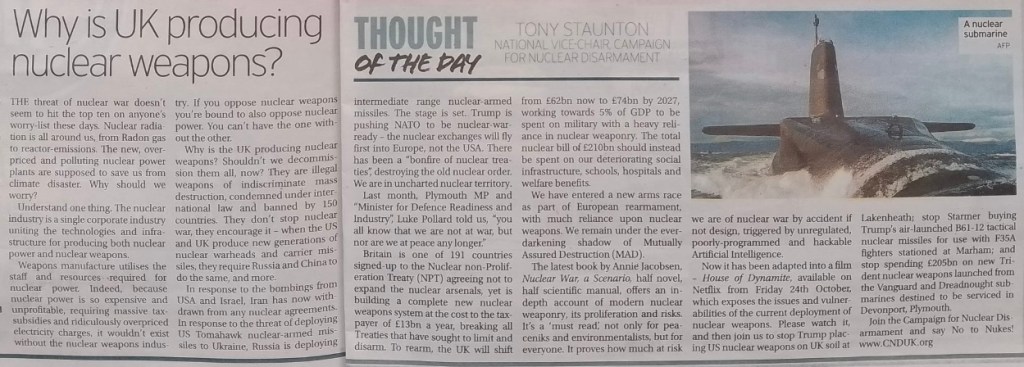
The threat of nuclear war doesn’t seem to hit hit the top ten on anyone’s worry-list these days. Nuclear radiation is all around us, from Radon gas to reactor-emissions. The new, overpriced and polluting nuclear power plants are supposed to save us from climate disaster. Why should we worry?
Understand one thing. The nuclear industry is a single corporate industry uniting the technologies and infrastructure for producing both nuclear power and nuclear weapons. Weapons manufacture utilises the staff and resources required for nuclear power. Indeed, because nuclear power is so expensive and unprofitable, requiring massive tax-subsidies and ridiculously overpriced electricity charges, it wouldn’t exist without the nuclear weapons industry.
If you oppose nuclear weapons you’re bound to also oppose nuclear power. You can’t have the one without the other.
Why is the UK producing nuclear weapons? Shouldn’t we decommission them all, now? They are illegal weapons of indiscriminate mass destruction, condemned under international law and banned by 150 countries. They don’t stop nuclear war, they encourage it – when the US and UK produce new generations of nuclear warheads and carrier missiles, they require Russia and China to do the same, and more. In response to the bombings from USA and Israel, Iran has now withdrawn from any nuclear agreements. In response to the threat of deploying US Tomahawk nuclear-armed missiles to Ukraine, Russia is deploying intermediate-range nuclear-armed missiles. The stage is set.
Trump is pushing NATO to be nuclear-war-ready – the nuclear exchanges will fly first into Europe, not the USA. There has been a “bonfire of nuclear treaties”, destroying the old nuclear order. We are in new and uncharted nuclear territory. Last month, Plymouth MP and “Minister for Defence Readiness and Industry”, Luke Pollard told us, “you all know that we are not at war, but nor are we at peace any longer.”
Britain is one of 191 countries signed-up to the Nuclear non-Proliferation Treaty (NPT) agreeing not to expand the nuclear arsenals, yet is building a complete new nuclear weapons system at the cost to the tax-payer of £13bn a year, breaking all Treaties that have sought to limit and disarm.
To rearm, the UK will shift from £62bn now to £74bn by 2027, working towards 5% of GDP to be spent on military with a heavy reliance in nuclear weaponry. The total nuclear bill of £210bn should instead be spent on our deteriorating social infrastructure, schools, hospitals and welfare benefits.
We have entered a new arms race as part of European rearmament, with much reliance upon nuclear weapons. We remain under the ever-darkening shadow of Mutually Assured Destruction (MAD).
The latest book by Annie Jacobsen, “Nuclear War, a Scenario”, half novel, half scientific manual, offers an in-depth account of modern nuclear weaponry, its proliferation and risks. It’s a “must read”, not only for peaceniks and environmentalists, but for everyone. It proves how much at risk we are of nuclear war by accident if not design, triggered by unregulated, poorly-programmed and hackable Artificial Intelligence.
Now it has been adapted into a film – “House of Dynamite” available on Netflix from Friday 24th October, which exposes the issues and vulnerabilities of the current deployment of nuclear weapons. Please watch it, and then join us to stop Trump placing US nuclear weapons on UK soil at Lakenheath, stop Starmer buying Trump’s air-launched B61-12 tactical nuclear missiles for use with F35A fighters stationed at Marham, and stop spending £205bn on new Trident nuclear weapons launched from the Vanguard and Dreadnought submarines destined to be serviced in Devonport, Plymouth. Join the Campaign for Nuclear Disarmament and say No to Nukes! http://www.CNDUK.org
_——————-
The threat of nuclear radiation doesn’t hit the top twenty on anyone’s worry-list these days. We’re mostly surviving despite it. Indeed, X-Rays of our lungs and organs are routine, despite releasing the ionising radiation and radioactive particles can cause cancer by damaging DNA. We want the medical diagnosis. How many tumours are caused by radiation damage is not known. The fact of the damage is well proven, not least from the aftermath of the bombs on Hiroshima and Nagasaki, and the meltdowns at Chernobyl and Fukushima nuclear power stations. Radiation makes people sick.
More locally, the naturally occurring radon gas, formed by decaying uranium found in rocks, is now the subject of controversy at Dartmoor prison – closed-down simply because of radioactive contamination. Radon is a leading cause of cancer in the UK and jail staff supported by their trade union, alongside up to 300 prisoners and former inmates, are seeking a legal challenge over their potential exposure to the gas. Uranium is the hard-to-refine ore essential to the production of nuclear reactors and nuclear weapons.
Plymouth is built upon the same radioactive rock and radon is a recognised threat inside our buildings. That may have been one of the criteria for Plymouth being the chosen centre for nuclear vessels and the Trident nuclear weapons-carrying submarines. Just add some more nuclear radiation to the already-present radioactive cluster, who would notice? In hindsight that wasn’t so clever. It costs the Ministry of Defence more than £30million each year to keep the 13 rotting hulks of nuclear subs from emitting the deadly pollution into our City. In any case, how would we know what radiation levels are attributable to the Devonport nuclear dockyard?
We know that radiation is dangerous and causes sickness and death. However you look at it, nuclear energy is not “clean energy” as currently described by Starmer’s government. And nuclear power is not a renewable. It produces radioactive waste. In every plan for new nuclear power plants, large or small, there is no costing for the “clean-up” and storage of radioactive waste some of which takes hundreds and even thousands of years to decay to a safe level.
We’ll have to just live with it, you say, and anyway “they” will solve the waste problem (whoever they are), eventually. Campaigners against the Sellafield new nuclear build are demanding that the Chancellor of Exchequer adds the cost of radioactive waste storage to the already astronomical cost of the nuclear power plant – the technology now completely outdated and redundant because of the rise of real renewables – energy production from solar, wind and wave power. The private corporations profiting from nuclear will never accept liability – the multi-billion cost of clean-up forever a liability for the tax-payer.
Understand one thing. The nuclear industry is a single corporate industry uniting the technologies and infrastructure for producing both nuclear power and nuclear weapons. Weapons manufacture needs the staff and resources in place because of the much larger scale of resources required for nuclear power. Indeed, because nuclear power is so expensive and unprofitable without massive tax-subsidies and the overpriced charges to the consumer, it wouldn’t exist without the nuclear weapons industry. If you oppose nuclear weapons you’re bound to oppose nuclear power. You can’t have the one without the other.
So why nuclear weapons? Surely we should decommission them all, now? They are illegal weapons of indiscriminate mass destruction, the subject of international law and banned by 148 countries. They don’t stop nuclear war, they encourage it – when the US and UK produce new generations of nuclear warheads and carrier missiles, they require Russia and China to do the same, and more. In response to the bombings from USA and Israel, Iran has now withdrawn from any nuclear agreements. In response to the potential use of US Tomahawk missiles, Russia has once again said it will deploy intermediate-range nuclear-armed missiles.
Trump is pushing NATO to nuclear-readiness – the nuclear exchanges will fly first into Europe, not the USA. There has been a “bonfire of nuclear treaties”, destroying the old nuclear order. We are in new and uncharted nuclear territory. Last month, Plymouth MP and “Minister for Defence Readiness and Industry”, Luke Pollard told us, “you all know that we are not at war, but nor are we at peace any longer.”
Britain is a signatory to the Nuclear Proliferation Treaty agreeing not to expand the nuclear arsenals, yet is building a complete new nuclear weapons system at the cost to the tax-payer of £13bn a year, breaking all Treaties that have sought to limit and disarm. To rearm, the UK will shift from £62bn now to £74bn by 2027, working towards 5% of GDP to be spent on military with a heavy reliance in nuclear weaponry. All this at a huge cost to our deteriorating social infrastructure, schools, hospitals and welfare benefits.
We have entered a new arms race as part of the European rearmament drive, with much focus being on nuclear weapons. We remain under the ever-darkening shadow of Mutually Assured Destruction (MAD).
The latest book by Annie Jacobsen, “Nuclear War, a Scenario”, half novel, half scientific manual, offers an in-depth account of modern nuclear weaponry, its proliferation and risks. It’s a “must read”, not only for peaceniks and environmentalists, but for everyone. It proves how much at risk we are of nuclear war by accident if not design, aided and abetted by unregulated, poorly-programmed and unmanageable Artificial Intelligence.
Now it has been adapted into a film – “House of Dynamite” a “must see”! Opening on Netflix this Friday evening, 24th October, it exposes the issues and vulnerabilities of the current development and placement of nuclear weapons. Please watch it, and then pledge to join us to stop Trump placing US nuclear weapons on UK soil at Lakenheath, and stop Starmer buying Trump’s air-launched B61-12 tactical nuclear missiles for use with F35A fighters stationed at Marham, and from spending £205bn on new Trident nuclear weapons launched from the Vanguard and Dreadnought subs destined to be serviced in Devonport, Plymouth. Join the Campaign for Nuclear Disarmament and say No to Nukes!
 Emotional Climate