

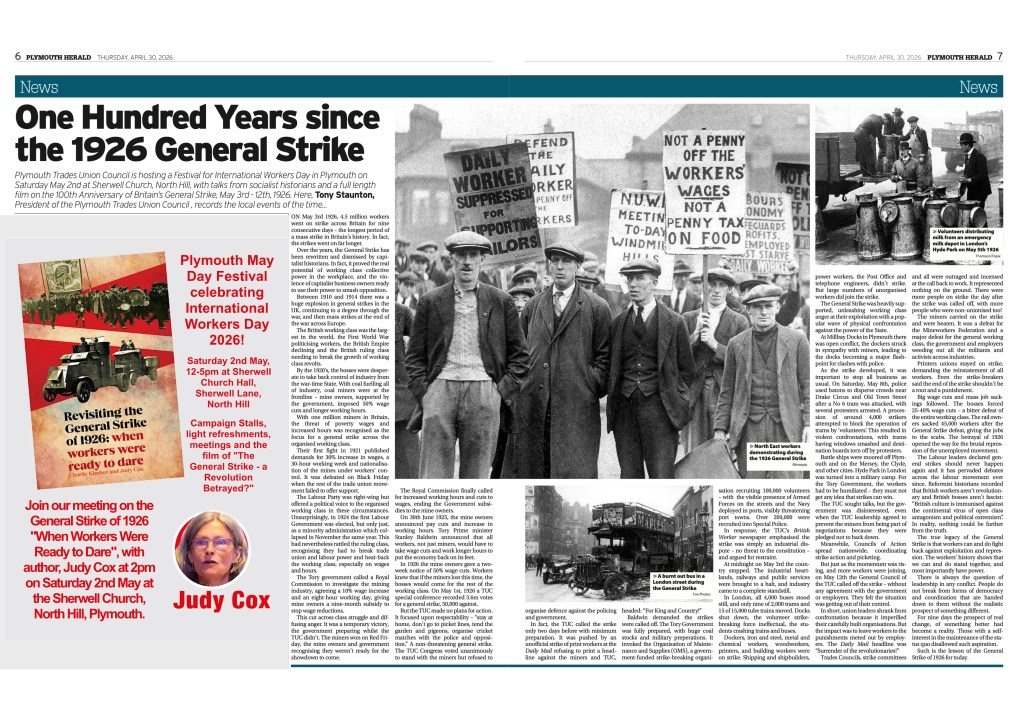
My two-page reflection on the General Strike 1926, published in the Plymouth Herald (30.4.26). The synopsis reflects the mood of the new book by socialist historians Judy Cox and Charlie Kimber, long term comrades, reminding the world that workers can and do fight, and workers in Britain have joined in mass dispute over and over again, including throughout my lifetime. The sell-out of the General Strike was used by Capitalist historians, including the reformist Labourites, the Webbs, to impose the cultural and political imposition against mass strike action, indeed, to undermine and criticise any and all strike action ever since. This top-down bureaucratic domination of the Labour Movement has plagued the working class ever since. I have always fought and organised for rank-and-file bottom-up collective action emanating from workplaces and working class communities. It will erupt again, the pay and job cuts and rate of gross exploitation too tense to be permanent or managed. The Workers, United, will never be Defeated!
One Hundred Years since the British General Strike
Plymouth Trades Union Council is hosting a Festival for International Workers Day in Plymouth on Saturday 2nd May at Sherwell Church, North Hill, with talks from socialist historians and a full length film on the 100th Anniversary of Britain’s General Strike 3-12th May 1926. Here, Tony Staunton, records the local events of the time.
On May 3rd 1926 four-and-a-half million workers went on strike across Britain for 9 consecutive days the longest period of a mass strike in Britain’s history. A real working class challenge to the UK government. In fact the strikes went on far longer.
The General Strike has been rewritten and dismissed by Capitalist historians. In fact it proved the real potential of working class collective power in the workplace, and the violence of the capitalist business owners ready to use their power to smash opposition.
General workers unions from the 1880’s had seen the match-girls strikes, 1910-14 huge explosion in general strikes in UK, continuing to a degree through the war, and then mass strikes at the end of the war across Europe. A new strike wave saw half of Britian on strike in 1919, including many police forces, pushing for better pay and conditions.
The British working class was the largest in the world, the First World War politicising workers, the British Empire declining and the British ruling class needing to break the growth of working class revolts. By the 1920’s, the bosses were desperate to take back control of industry from the war-time State. With coal fuelling all of industry, coal miners were at the frontline – mine owners supported by the government for privatisation and immediately imposing 50% wage cuts and longer working hours.
With one million miners in Britain, the threat of poverty wages and increased in hours was recognised as the focus for a general strike across the organised working class. Their first fight in 1921 published demands for 30% increase in wages, a 30-hour working week and nationalisation of the mines under workers’ control. It was defeated on Black Friday when the rest of the trade union movement failed to offer support.
The Labour Party was right-wing but offered a political voice to the organised working class in these circumstances. Unsurprisingly, in 1924 the first Labour Government was elected, but only just, as a minority administration which collapsed in November the same year. This had nevertheless rattled the ruling class recognising they had to break trade union and labour power and beat-back the working class especially on wages and hours
The Triple Alliance came in support of the Miners: Miners, Railways and Transport workers, pushing their own demands. The Tory government called a Royal Commission to investigate the Mining Industry, agreeing a 10% wage increase and a 8-hour working day, giving mine owners a 9-month subsidy to stop wage reductions.
This cut across class struggle and diffusing anger. It was a temporary victory, the government preparing whilst the TUC didn’t. The Miners won on Red Friday, the mine owners and government recognising they weren’t ready for the showdown to come.
The Royal Commission finally called for increased working hours and cuts to wages, ending the Government subsidies to the mine owners. On 30th June 1925 the Miners Owners announced pay cuts and increase in working hours. Tory Prime minister Stanley Baldwin announced in parliament that all workers, not just miners, would have to take wage cuts and work longer hours to put the economy back on its feet.
In 1926 the Mine owners gave a 2-week notice of 50% wage cuts. Workers knew that if the miners lost this time, the bosses would come for the rest of the working class. On 1st May 1926 a general vote of TUC special conference recorded 3.6m for a GS, 50,000 against. The TUC made no plans for action. It focussed upon respectability – “stay at home, don’t go to picket lines, tend the garden and pigeons, organise cricket matches with the police and opposition”. A non-threatening general strike! The TUC Congress voted unanimously to stand with the Miners but refused to organise defence against the policing and government.
In fact, the TUC called the strike only 2 days before with minimum preparation. It was pushed by an unofficial strike of printer workers at the Daily mail refusing to print a headline against the Miners and TUC headed “For King and Country!”. Baldwin demanded the strikes were called-off. The TUC repudiated the Daily Mail strike but the Government snubbed them.
The Government was fully prepared, with huge coal stocks and military preparations, and wanted the strike. It had imprisoned most of the leadership of the British Communist Party along with thousands of known militants, and shut down leftwing newspapers and political meetings.
The Tory Government invoked the Organisation of Maintenance and Supplies (OMS) a government-funded paramilitary strike-breaking organisation recruiting 100,000 mainly middle class volunteers – with contacts between the Tory Government, the British Union of fascists and the visible presence of the Armed Forces on the streets, not least the Navy deployed in ports visibly threatening port towns. Over 200,000 were recruited into special Police.
The Government ensured a broad propaganda campaign against the strike, setting-up the daily “British Gazette” edited by Winston Churchill to organise a “scab army” of strike-breakers, facilitated but the Daily Mail and Daily Express. The editorial was that the strike is a threat to country, the monarchy, the Empire, to law and order, the family and the Christian religion.
The BBC ensured repeated appeals for scab recruitment, fake reports of mass defections from the strike. The head of the Catholic Church came out to declare that the strike was a sin against God!
In response, the “British Worker” newspaper was set up by the TUC emphasising that the strike was simply an industrial dispute, no threat to the Constitution, and arguing for restraint. TUC leadership organised against any and all semblance of rank and file organisation, and used the local trades councils to prevent or reign-in the Councils of Action (local Strike Committees for agitation and propaganda, demanding all power to the TUC General Council “for the preservation of peace and order”.
At midnight on 3rd May the country stopped. The industrial heartlands, railways and public services brought to a halt, industry came to a complete standstill. In London al 4,000 buses stood still, 9 of 2,000 trams and 15 out of 15,000 tube trains moved. Docks shut down, the volunteer strike-breaking force ineffectual, the students crashing trains and buses.
Dockers, Iron and Steel, metal and chemical workers, woodworkers, printers, building workers on strike. Shipping and shipbuilders, power workers, the Post office and telephone engineers, didn’t strike although many came out during the 9 days. Large numbers of unorganised workers joined the strike – nobody wanted to be that person seen to be on the side of the bosses.
The General Strike was heavily supported, mass pickets on 4th May stopping scabs, fierce street battles including deaths, trucks and cars and busses set alight, railway stations invaded to stop transport. Women laid babies on the road to stop scab vehicles and allow the drivers to be evicted and engines to be broken.
The General Strike unleashed working class anger at their exploitation with a popular wave of physical confrontation against the power of the State. Women’s organisations ensured infrastructure for the strike, including financial levies for universal welfare and organised groups to challenge strike-breakers.
At Millbay Docks in Plymouth there was open conflict, the Dockers struck in sympathy with miners, leading to the docks becoming a major flashpoint for clashes with police. As the strike developed, it was important to stop all business as usual. On Saturday, 8 May, Police used batons to disperse crowds near Drake Circus and Old Town Street after a No 6 tram was attacked, with several protesters arrested. A procession of around 4,000 strikers attempted to block the operation of trams by “volunteers”. This resulted in violent confrontations, with trams having windows smashed and destination boards torn off by protesters.
Battle ships were moored off Plymouth and on the Mersey, the Clyde, and other cities. Hyde Park in London was turned into a military camp. For the Tory Government, the workers had to crawl back to work humiliated. The working class must not get any idea that strikes can win.
The TUC sought talks, the government disinterested, even when the TUC leadership agreed to prevent the Miners from being part of negotiations because they were pledged not to back down. Meanwhile, Councils of Action spread across the country from the 2nd Day coordinating strike action, picketing, permits for transport and workers defence forces.
Just as the momentum was rising and more workers were joining, on 12th May the General Council of the TUC called-off the strike, without any agreement with the government or employers. They felt the situation was getting out of their control. In short, the union leaders shrank from confrontation because it imperilled their carefully built organisations. But the impact was to leave workers to the punishments meted out by the employers.
The Daily Mail headline “surrender of the revolutionaries!” Trades Councils, strike committees and all were outraged and incensed at the call back to work. It represented nothing on the ground. There were more people on strike the day after the strike was called-off, with more people who were non-unionised too! It took time to quell the fight.
The Miners carried-on the strike and were beaten. It was a defeat for the Mineworkers Federation and a major defeat for the general working class, the government and employers weeding-out all the militants and activists across industries.
Printers unions stayed on strike demanding the reinstatement of all workers. Even the strike-breakers said the end of the strike shouldn’t be a rout and a punishment. Big wage cuts and job mass sackings followed. The Bosses stated “you’ve got nothing” and forced 25-40% wage cuts – a bitter defeat of the entire working class. The rail owners sacked 45,000 workers after the GS defeat, giving the jobs to the scabs.
The betrayal of 1926 opened the way for the brutal repression of the Unemployed Movement, the 1932 Great Hunger March assaulted by Police, all leaders jailed in the 1930s and State assaults on the anti-fascist mobilisations before and after the second world war.
The Labour leaders declared general strikes should never happen again. It has pervaded debates across the labour movement ever since. The reformist historians, the Webb’s recorded that British workers aren’t revolutionary and British bosses aren’t fascist: “British culture is immunised against the continental virus of open class antagonism and political extremism”. In reality, nothing could be further from the truth.
The true legacy of the General Strike is that workers can and do fight back against exploitation and repression. The worker’s history shows that we can and do stand together, and most importantly have power. There is always the question of leadership in any conflict. People do not break from forms of democracy and coordination that are handed down to them without the realistic prospect of something different. For 9 days the prospect of real change, of something better had become a reality. Those with a self-interest in the maintenance of the status quo disallowed such aspiration. Such is the lesson of the General Strike of 1926 for today.
Tony Staunton
President, Plymouth Trades Union Council
 Emotional Climate