
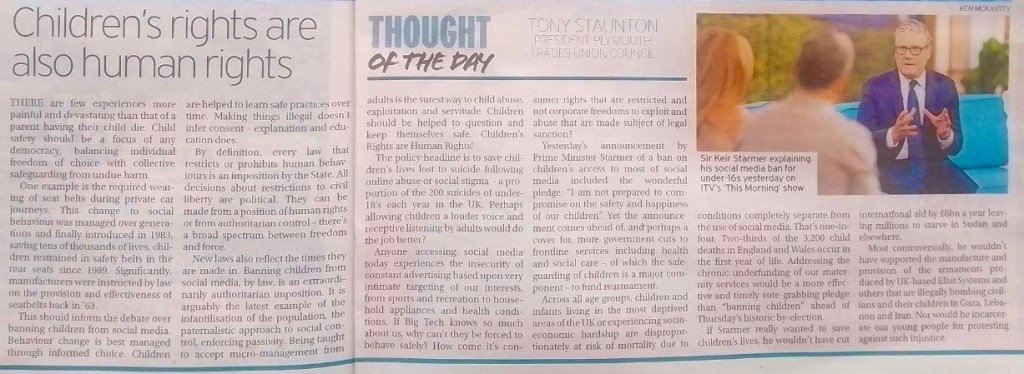
My weekly comment column in the daily Plymouth Herald newspaper (16.6.26), exposing Starmer’s hypocrisy once again. This time, the rampant authoritarianism of banning children online. Socialists are for individual empowerment and informed choice towards full self-determination in a society based upon equality and diversity. Not regimentalism and authoritarian micro-management of behaviours. We cannot allow the infantilisation of another generation, bred to be wage slaves and cannon fodder. It does not require us to pander to AI and the Big Tech billionaires in order to uphold children’s rights – we are required to challenge the corruption of the internet in the pursuit of outrageous profits.
The unedited article below and online, the printed version able to read by buying the paper (!) or expanding the picture:
Children’s Rights are Human Rights! (not my headline, but hey)
There are few experiences more painful and devastating than that of a parent having their child die. We want every child to grow into adulthood in a society safe enough to ensure love and nurture over anxiety and pain. Child safety is a focus of any democracy, balancing individual freedom of choice with collective safeguarding from undue harm.
One contemporary example is the required wearing of seat belts during private car journeys. The change to social behaviour was managed over generations with few people objecting to the law when finally introduced in 1983, saving tens of thousands of lives, children restrained in safety belts in the rear seats since 1989. Significantly, manufacturers were instructed by law on the provision and effectiveness of seatbelts back in ’63.
This should inform the debate over banning children from social media. Behaviour change is best managed through informed choice. Children, and indeed adults, are helped to learn safe practices over time – belt up! Over time, such a culture becomes second nature. Making things illegal doesn’t infer consent – explanation and education does.
Most importantly, manufacturers should be forced to take the lead responsibility in providing safe-enough goods and services.
By definition, every law that restricts or prohibits human behaviours is an imposition by the State. All decisions about restrictions to civil liberty are political. They can be made from a position of human rights or from authoritarian control – there’s a broad spectrum between freedom and force.
New laws also reflect the times they are made in. Banning children from social media, by Law, is an extraordinarily authoritarian imposition. It is arguably the latest example of the infantilisation of the population, the paternalistic approach to social control, enforcing passivity. Children should not be taught to accept micro-management from adults – the surest way to abuse, exploitation and servitude. Children should be helped to keep themselves safe. Its called “growing-up”.
The policy headline is to save children’s lives lost to suicide following online abuse or social stigma, a proportion of the ghastly 200 suicides of under-18’s each year in the UK. Perhaps allowing children a louder voice and a receptive listening by adults would do the job better?
By comparison, the social media Tech Corporations will be cautioned to produce safeguards, tho’ their owners are unlikely to ever limit their profiteering or be prosecuted in a way that parents and over-14’s will be. There’s an imbalance to the advantage of Big Tech, these giant Corporations grossing income many times most countries each year. It is a brave Government that legislates against them. Children are a far easier target.
Anyone accessing social media today experiences the insecurity of constant advertising based upon very accurate targeting of our interests, from sports and recreation to household appliances and intimate health conditions. If Big tech knows so much about us, why can’t they be forced to behave safely? How comes its consumer rights that are restricted and not Corporate freedoms to exploit and abuse that are made subject of legal sanction?
Yesterday’s announcement by Prime Minister Starmer of a ban on children’s access to most of social media included the wonderful pledge: “I am not prepared to compromise on the safety and happiness of our children”. Yet the announcement comes ahead of, and perhaps a cover for, more government cuts to frontline services including health and social care – of which the safeguarding of children is a major component – to fund rearmament. Plymouth Child Protection services are in chronic funding crisis.
Across all age groups, children and infants living in the most deprived areas of the UK or experiencing socio-economic hardship are disproportionately at risk of mortality due to conditions completely separate from the use of social media. Four million of “our” children.
Two-thirds of the 3,200 child deaths in England and Wales occur in the first year of life. Addressing the chronic underfunding of our maternity services would be a more effective, money for Youth Centres and recreation would be more timely and vote-grabbing pledges rather than “banning children” ahead of Thursday’s historic by-election.
This is headline-grabbing hypocrisy.
If Starmer really wanted to save children’s lives, he wouldn’t have cut international aid by £6bn a year leaving millions to starve in Sudan and elsewhere. He wouldn’t be cutting the cash to address the climate crisis – the crucial safeguard for all children’s futures. Most controversially, he wouldn’t have supported the manufacture and provision of the armaments produced by UK-based Elbit Systems and others that are illegally bombing civilians and their children in Gaza, Lebanon and Iran. Nor would he condemn as terrorists and incarcerate our young people for protesting against such injustice.
 Emotional Climate