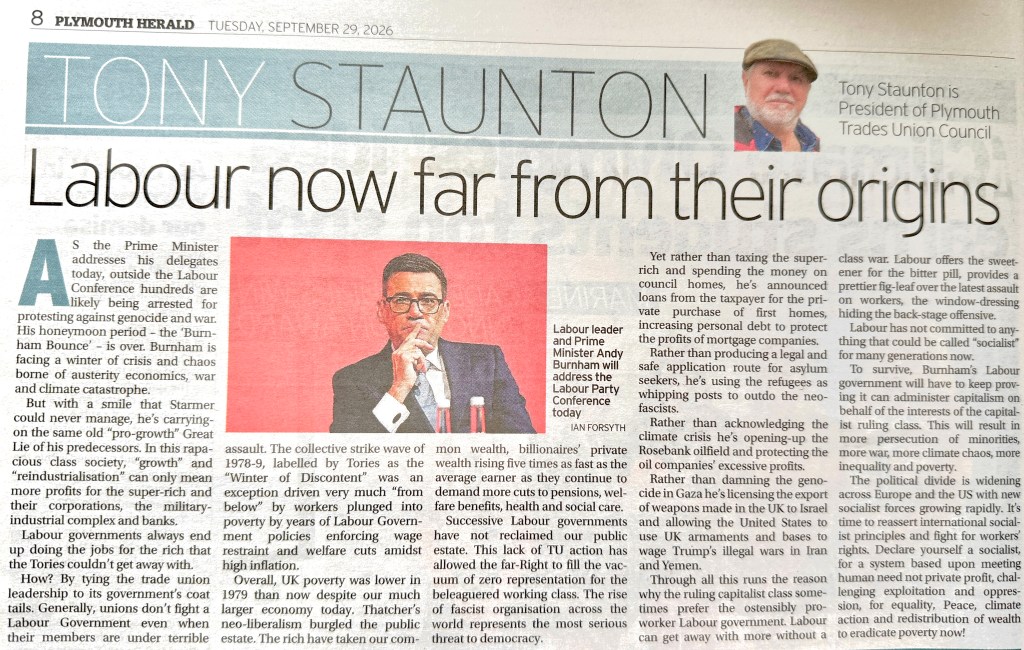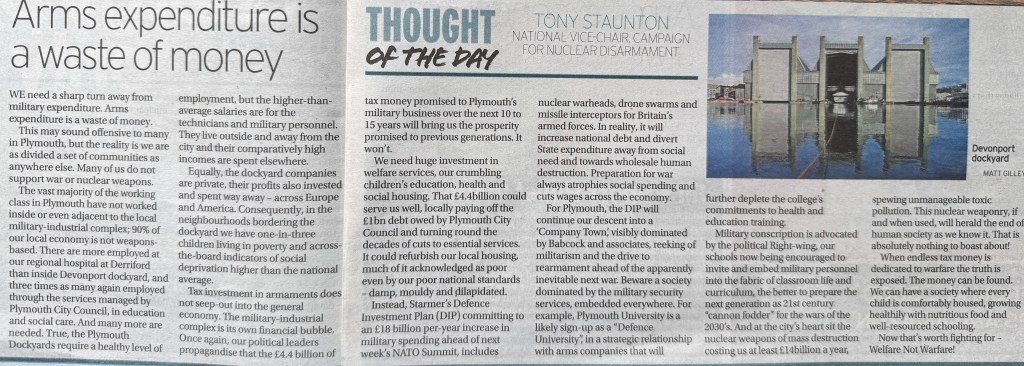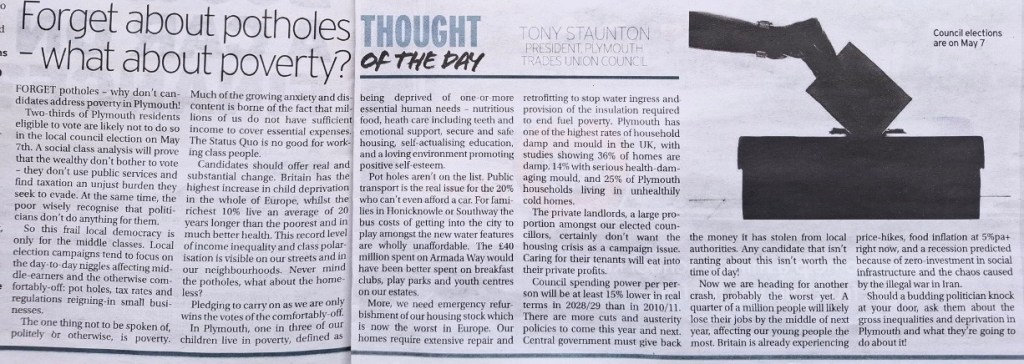
My weekly Column in the daily Plymouth Herald (29th September 2026), addressing the Labour Party Conference from afar. This was written a day before Burnham’s speech which sought to rally a beleaguered Party around working class issues. I stand by what I wrote. It was pie-in-the-sky with sleight-of-hand pledges, for example, cutting the pensioners triple-lock security while promising unspecified future help with social care. No mention of the challenge of rising fascism, racism and misogyny, and whispered asides on climate change and war. Capitalism is in global polycrisis globally and this Prime Ministerial address drowned in its denial. Time will unravel the pledges and expose the deceit.
Below is my unedited draft, or please expand the picture to read the published version. I would not have chosen their headline. Here’s mine.
We need an international socialist movement
When a prime minister declares they will not be calling a general election you can be sure they’re under mounting pressure to do so. The honeymoon period, the “Burnham Bounce”, is already over. Burnham is facing a winter of crisis and chaos borne of Austerity economics, war and climate catastrophe.
Political activists, left, right and centre wanted to see the back of Starmer. Whatever your concern, he wasn’t helping. Of course, in a class society based upon extremes of wealth and deprivation, individual power and competition, you can’t please everyone all the time. But it takes a special skill to please no-one at all.
You have to choose sides and take a political position. And Burnham has.
Quietly, and with a smile that Starmer could never manage, he’s carrying-on the same old “pro-growth” Great Lie of all his predecessors. In this rapacious class society, “growth” and “re-industrialisation” can only mean more profits for the super-rich and their corporations, almost exclusively the military-industrial complex.
Labour, as always, ends up doing the jobs for the Rich that the Tories couldn’t get away with.
How? By tying the trade union leadership to its governmental coat tails. Generally, unions don’t fight a Labour Government even when their members re under terrible assault. The collective strike wave of 1978-9, labelled by Tories as the “Winter of Discontent” was an exception driven very much “from below” by workers plunged into poverty by Labour policies forcing wage restraint and welfare cuts amidst high inflation.
Overall, UK poverty was lower in 1979 than today despite a much larger economy. The rich have gotten richer, billionaires’ wealth rising five times as fast as the average earner.
The lack of TU action has allowed the far-Right to fill the vacuum of zero representation for the beleaguered working class. It’s happened time-and-again in our history. But this time the level of fascist organisation across the world funds and informs the most serious threat to democracy.
Yet Burnham is looking rightwards, seeking to compete and placate the racist bigots when he should be beating back the corrupt profiteering of the super-rich landlords and corporate executives.
Rather than taxing the super-rich and spending the money on council homes, he’s announced loans from the taxpayer for the private purchase of first homes, protecting the profits of the banks and mortgage companies.
Rather than repealing Tory laws and producing a legal and safe application route for asylum seekers, he’s using the refugees from the global south as whipping posts to outdo the neo-fascists.
Rather than publishing last year’s UK government climate national security report suppressed by Starmer, he’s briefing other governments on impending collapse of ecosystems across the world whilst opening-up Rosebank and other fossil fuel sources at home.
Rather than damning Israel’s genocide in Gaza he’s still licensing the supply of weapons made in the UK to Israel, and allowing the United States to use UK bases to wage Trump’s illegal wars in Iran and Yemen.
Through all this runs the reason why the ruling capitalist class sometimes prefer the ostensibly pro-worker Labour Government to an honestly pro-Capitalist class Tory or Reform led government. Labour can get away with more without a class war.
Labour plays the bait-and-switch approach, offers the sweetener for the bitter pill, provides a prettier fig-leaf over the latest abuse, the window-dressing hiding the back-stage offensive.
So give a small amount of extra cash to councils and communities to cover-up the massive tax-allowances to the finance corporations.
Allow Milliband wax-lyrical about green energy targets whilst continuing to subsidise and protect fossil-fuel use and the extreme profits of the oil companies.
Labour has not committed to anything called “socialist” for many generations now. Callaghan made cuts to the Welfare State much larger in one full-swoop than anything Thatcher managed. Blair privatised more of the public estate than any other prime minister ever. Starmer followed in Blair’s shadow, and worse.
Capitalists depend on our taxes to fund the modicum of social infrastructure they need for workers to be fit enough and able to travel to work. We pay for our health and social care, not them. Sometimes they accept a about Government to rebuild the modicum of social infrastructure they need for workers to be fit enough and able to travel to work. We pay for our health and social care, not them.
Burnham is not a socialist. He’s a player. And his Labour government will continue the role of administering Capitalism on behalf of the interests of the capitalist ruling class. This will result in more racism and persecution of minorities, more war, more climate chaos, more inequality and poverty.
And every Party to the Right will produce an even worse result.
The political divide is strengthening across Europe and the US with new socialist forces growing rapidly. It’s time to reassert international socialist principles and fight for workers’ rights. In Germany the far-Right has electorally taken the East whilst the big cities have shifted far to the socialist Left. In the United States the openly Democratic Socialist Party has endured the election of Mamdani in New York and is building a serious left alternative to Trump’s militarism, racism and misogyny.
Its time to reassert socialist principles and fight for workers’ rights. Declare yourself a socialist, for a system based upon meeting human need not private profit, challenging exploitation and oppression, for equality, Peace, climate action and redistribution of wealth to eradicate poverty now!