

My Weekly Comment column in the daily Plymouth Herald (28.2.25), delayed from its usual Tuesday slot for “technical reasons”, allowing for a Comment Column from the editor supporting more war with Russia, and then a military person writing on the need for emergency weapons production. Last week’s column was stopped by the editor, my call for peace being identified as similar to “seeking to appease Hitler” (ie Putin).
Last week I warned of Europe promoting world war three against Russia. Today my weaker and compromised column warns only of Trump, not NATO and Starmer. Bizarrely, by the evening of the 28th, Trump had been broadcast across the world bullying and condemning Zelenskyy to his face in the Oval Office.
So when Trump spoke again of World War Three I kinda feel vindicated, while wishing I’d argued harder and stuck to my guns. I should have learnt by now – don’t compromise!
This week’s column:
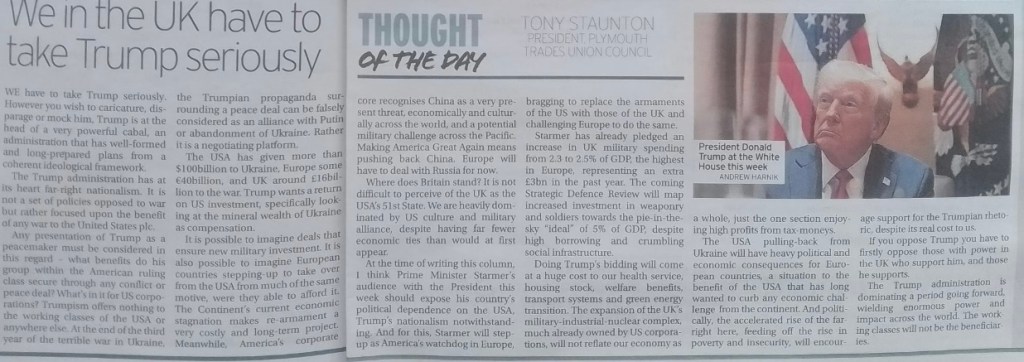
We have to take Trump seriously. However you wish to caricature, disparage or mock him, Trump is at the head of a very powerful cabal, an administration that has well-formed and long-prepared plans from a coherent ideological framework.
The Trump administration has at its heart, far-right nationalism, separate from the Project for New American Century of the 1990’s. It is not a set of policies opposed to war, reference Iraq and Afghanistan, but rather focussed upon the benefit of any war to the United States plc.
Any presentation of Trump as a peacemaker must be considered in this regard – what benefits do his group within the American ruling class secure through any conflict or peace deal? This is not particularly a question of likes and dislikes, just what’s in it for the US corporations. Trumpism offers nothing to the working classes of the USA or anywhere else.
At this juncture, the acknowledgement of the third year of war in Ukraine, the Trumpian propaganda surrounding a peace deal can be falsely considered as an alliance with Putin or abandonment of Ukraine. Rather it is a negotiating platform. The USA has given more than $100billion to Ukraine to fund the war, plus Musk’s Starlink satellite communication systems and much else of the essential military infrastructure, and Trump wants to see a return on the investment.
Trump has said he wants the mineral wealth of Ukraine in return for continued provision of arms. This is not to be condoned, but is not the same as abandonment. It is possible to imagine deals that ensure new military investment. It is also possible to imagine European countries stepping-up to take-over from the USA, from much of the same motive were they able to afford it. The current economic stagnation makes rearmament a very long-term project.
Trump says his country is shielded by a beautiful ocean, the Atlantic, making Russia, a much smaller economy than the USA, of little or no threat to him. By contrast, America’s corporate core recognises China as a very present threat, economically and culturally across the world, and potentially militarily across the Pacific.
Making America Great Again means pushing back against China and its BRICS alliance. Europe will have to deal with Russia.
So where does Britain stand? It is not difficult to perceive of the UK as tThe USA’s 51st State. We are heavily dominated by US culture and military alliance despite having far fewer economic ties than would at first appear.
Prime Minister Starmer’s audience with the President this week should expose his country’s political dependence on the USA, Trump’s nationalism notwithstanding. And for this, Starmer will step-up as America’s watchdog in Europe, bragging to replace the armaments of the US with those of the UK and challenging Europe to do the same.
Starmer has already pledged an increase in UK military spending from 2.3 to 2.5% of GDP, the highest in Europe, representing an extra £3bn in the past year. The coming Strategic Defence Review will map increased investment in weaponry and soldiers towards the pie-in-the-sky “ideal” of 3% of GDP, despite high borrowing and crumbling social infrastructure.
Doing Trump’s bidding will come at a huge cost to our health service, housing stock, welfare benefits, transport systems and green energy transition. The expansion of the UK’s military-industrial complex, much already ownedd by US corporations, will not reflate our economy as a whole, just one section that is already enjoying record profits from tax-moneys.
The USA pulling-back from Ukraine will have heavy political and economic consequences for European countries, a situation to the benefit of the USA that has long wanted to curb the economic power of the continent. And politically, the accelerated rise of the far-Right here, feeding off the rise in poverty and insecurity, will encourage support for the Trumpian rhetoric, itself so two-faced in its true intention.
Some praise Trump for his transactional approach to power in a Capitalist world. His is an example of how Capitalism actually functions – as a constant competition between combatants, seeking to make offers that cannot be refused or actual hostile takeovers. Gangsters and the organised criminal gangs learnt all they know from the legitimate corporate players.
The challenge is this. If you oppose Trump you have to firstly oppose those with power in the UK who support him, and those he supports. The Trump administration is dominating a period going forward in which they can wield enormous power and impact across the world. They must be stopped.
 Emotional Climate