
My weekly column in the daily Plymouth Herald (15.7.25) calling for a fight for climate action, alongside everything else! If anyone hasn’t read the Met Office report, conservative in the extreme yet painfully dire in its predictions and concerns, then do so. In any case, out of existential self-interest or global climate justice, rebuild the climate movement, now!
Unexpurgated below (not my chosen headline!)
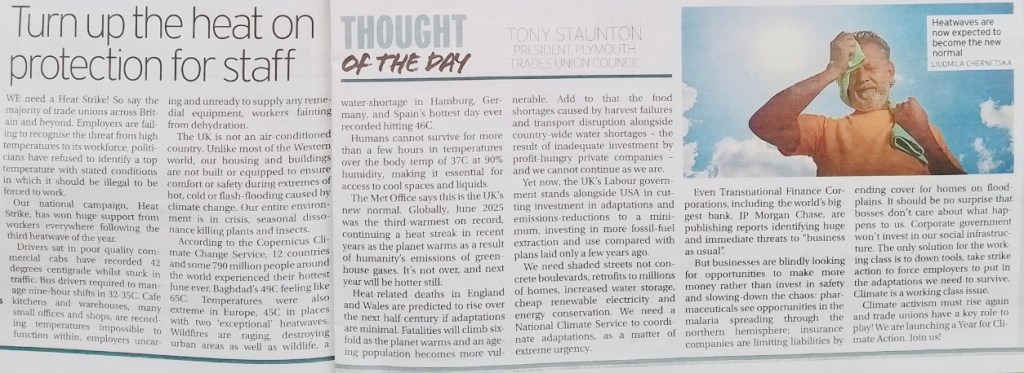
We need a Heat Strike! So say the majority of trade unions across Britain and beyond. Employers are failing to recognise the threat from high temperatures to its workforce, politicians have refused to identify a top temperature with stated conditions in which it should be illegal to be forced to work.
The national campaign, Heat Strike, has won huge support from workers everywhere following the third heatwave of the year.
Drivers sat in poor quality commercial cabs have recorded 42 degrees centigrade whilst stuck in traffic. Bus drivers required to manage 9-hour shifts in 32-35C. Cafe kitchens and warehouses, and many small offices and shops, are recording temperatures impossible to function within, employers uncaring and unready to supply any remedial equipment, workers fainting from dehydration.
The UK is not an air-conditioned country. Unlike most of the Western world, our housing and buildings are not built or equipped to ensure comfort or safety during extremes of hot, cold or flash-flooding caused by Climate Change. Our natural environment is in crisis, seasonal dissonance e killing plants and insects.
According to the EU Copernicus Climate Change Service (C3S), 12 countries and some 790 million people around the world experienced their hottest June ever, Baghdad’s 49C feeling like 65C.. Temperatures were particularly extreme in Europe, 45C in places with two ‘exceptional’ heatwaves. Wildfires are raging, destroying urban areas as well as wildlife, a water-shortage in Hamburg, Germany and Spain’s hottest day ever recorded hitting 46C.
Humans cannot survive for more than a few hours in temperatures over the body temp of 37C at 90% humidity, making it essential for access to cool spaces and liquids.
The Met Office says this is the new normal. Globally, June 2025 was the third-warmest on record, continuing a heat streak in recent years as the planet warms as a result of humanity’s emissions of greenhouse gases. It’s not over, and next year will be hotter still. Europe is warming several times faster than the global average, the sea levels rising around the UK faster than anywhere else, storms and coastal erosion destroying homes. Last winter was the UK’s wettest, with sudden deluges – 2-4 times the average rainfall last September, the cost of water ingress very high.
Heat-related deaths in England and Wales are predicted to rise 50-fold over the next half century if adaptations are minimal. Fatalities will climb six-fold as the planet warms and an ageing population becomes more vulnerable. Add to that the food shortages caused by harvest failures and transport disruption, alongside country-wide water shortages – the result of inadequate investment by profit-hungry private companies – and we cannot continue as we are.
Even the most crazed conspiracy theorists have stopped arguing that Climate Change is a hoax, now saying we have to roll with it or blaming some deep-State contrivance. Climate change is not about belief – t’s a fact. It used to be that only the far-Right and the ignorant argued against tax-investment in climate damage reduction
Yet now, the UK’s Labour government stands alongside USA in cutting investment in adaptations and emissions-reductions to a minimum, investing in more fossil-fuel extraction and use compared with plans laid only a few years ago. We need shaded streets not concrete boulevards, retrofits to millions of homes, increased water storage and energy conservation. We need a National Climate Service to coordinate adaptations, as a matter of extreme urgency.
Whilst all the scientific predictions broadcast by Greta Thunberg’s Youth Strike for Climate have come true, and worse, the campaign clamour for action that peaked back in 2019 has now died down despite evidence of the climate emergency being plain to see. Climate appears not to be an electoral priority.
But the people swept away in flash floods in Texas, USA, last week are a minuscule fraction of the havoc being wreaked right now by the heating of the atmosphere and oceans across the world. Contrary to Trump’s repeated one-in-a hundred-years false propaganda, the Americas are suffering repeated crisis costing their economies trillions of dollars a year. Transnational Finance Corporations, including the world’s biggest bank, JP Morgan Chase, are publishing reports to affiliates identifying huge and immediate threats to “business as usual”.
But businesses are looking for opportunities to make more money rather than invest in safety and slowing-down the chaos: pharmaceuticals can make big money out of malaria spreading through the northern hemisphere; insurance companies can limit liabilities by ending cover for homes on floodplains.
It should be no surprise that bosses don’t care about what happens to us. Corporate government won’t invest in our social infrastructure. The only solution for the working class is to down tools, take strike action to force employers to put in the adaptations we need to survive. Climate is a working class issue. Climate activism must rise again and trade unions have a key role to play! We are launching a Year for Climate Action from September 2025. Join us!
Tony Staunton
President, Plymouth Trades Union Council
 Emotional Climate