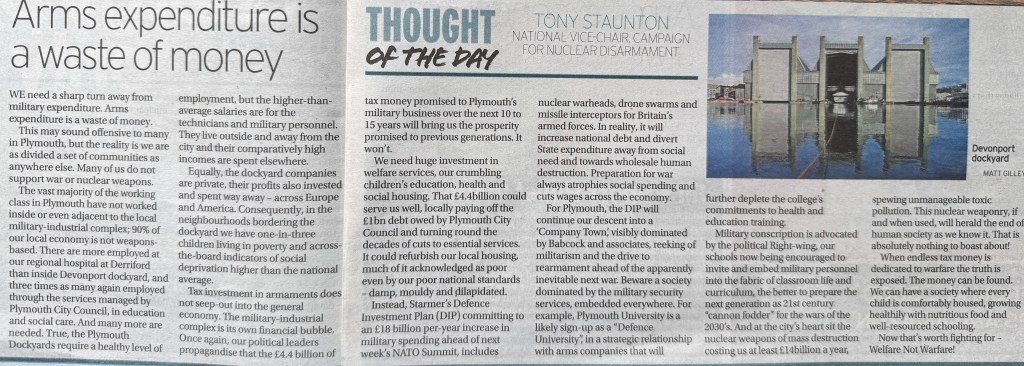
My weekly Comment Column in the daily Plymouth Herald Newspaper (2.6.26), rehearsing the necessary arguments against Starmer’s forthcoming increase in immediate arms spending, again. He is under pressure to deliver more UK war-preparations ahead of the major NATO Summit in July, and has to “find the money” – that is, defy his Chancellor and demand cuts to welfare. There is an element of Whitehall tittle-tattle, but the final analysis has to be that UK will be a frontline aggressor in the West’s drive to more warfare, pushed by Trump. Meanwhile, we dissolve into worker-on-worker violence – both social and military – or organise collectively to stop the warmongers.
The unedited version below:
We need a sharp turn away from military expenditure. Arms expenditure is a waste of money. This may sound offensive to many in Plymouth, but the reality is we are as divided a set of communities as anywhere else. The retired ex-military who have settled here, and the Yardies of yesterday and today, will stake their lives upon loyalty to armed forces and the arms corporations they’ve worked for all their lives. They are not alone in feeling pride in their work.
The majority of the working class in Plymouth have not worked inside or even adjacent to the local military-industrial complex. There are more employed at our regional hospital at Derriford than inside Devonport dockyard, and twice as many again employed through the services managed by Plymouth City Council, in education, social care and environmental services.
We have in no way benefitted from Plymouth being characterised as a Naval City, and we’re not about to benefit now. Plymouth Dockyards require a healthy level of craft services, but the higher-than-average salaries are for the technicians and military personnel. They live outside and away from the City and their comparatively high incomes are spent elsewhere.
Equally, the Dockyard companies are private, their profits also stored and spent way away – across Europe and America. Consequently, in the neighbourhoods bordering the dockyard we have one-in-three children living in poverty and across-the-board indicators of social deprivation higher than the national average. Plymouth is a poor city. The health and life-expectancy disparities between the working class living in the West of Plymouth and the white-collar professionals to the East, totally unacceptable.Our small middle class live around 14 years longer and with twenty years of better health than manual and semi-skilled workers.
Once again, our political leaders propagandise that the £4.4 billion of tax money promised to Plymouth’s military business over the next ten to fifteen years will bring us the prosperity promised to previous generations. It won’t.
We need huge investment in welfare services, our children’s education, health and social housing. That £4.4billion could serve us well, locally paying off the £1bn debt owed by Plymouth City Council and turning round the decades of cuts to essential services. It could refurbish our local housing, much of it acknowledged as poor by national standards – damp, mouldy and dilapidated.
Instead, Starmer’s Defence Investment Plan (DIP) committing to a £18 billion per-year increase in military spending ahead of next month’s NATO Summit, includes nuclear warheads, drone swarms and missile interceptors for Britain’s armed forces. In reality, it will increase national debt and divert State expenditure away from social need and towards wholesale human destruction. Preparation for war always atrophies social spending and cuts wages across the entire economy.
For Plymouth the DIP will continue our descent into a Company Town, visibly dominated by Babcock and associates, reeking of militarism and the drive to rearmament ahead of the apparently inevitable next war. Beware a society dominated by the military security services, embedded everywhere. For example, Plymouth University is a likely sign-up as a “Defence University”, in a strategic relationship with arms companies that will deplete the college’s commitments to health and education training even further.
Compulsory conscription is advocated by the political Right, our primary Schools now being encouraged, with funding, to invite and embed military personnel into the fabric of classroom life and curriculum, the better to prepare the next generation as twenty-first century “cannon fodder” for the wars of the 2030’s.
Future wars are portrayed as robot-wars conducted by technical experts fielding underwater and low-flying drones as if in a computer game. The reality of current wars in Ukraine and the Middle East show something very different. Drones and missiles destroying civilian targets, from high-rise flats to entire towns. This is the destructive force being the sole area of investment for Plymouth.
And at the City’s heart, the illegal mass exterminator, the weapons of mass destruction costing us at least £14billion a year and unmanageable toxic pollution. The nuclear weaponry that, if and when used will herald the end of human society as we know it. That is absolutely nothing to boast about!
When endless tax money is dedicated to warfare the truth is exposed. The money can be found. We can have a society where every child is comfortably housed, growing healthily with nutritious food and well-resourced schooling. Now that’s worth fighting for – Welfare Not Warfare!