

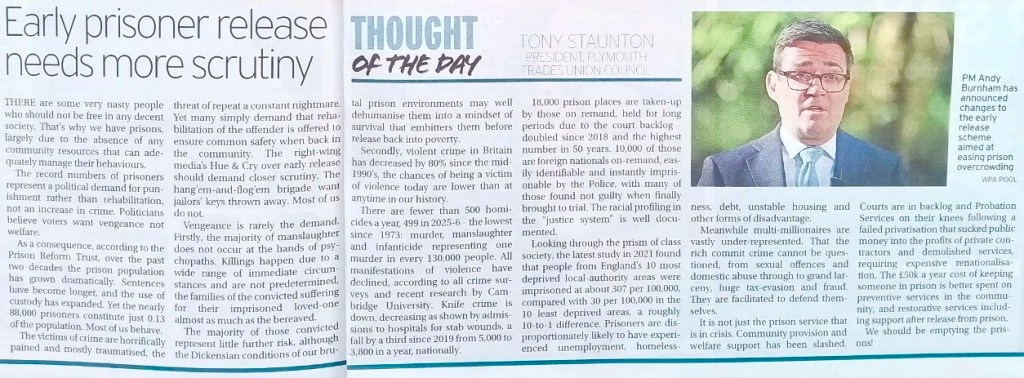
My weekly Comment column in the daily Plymouth Herald (1st September 2026), trying to counter the wall-to-wall right-wing media coverage of the prisons crisis, each and all focussed on the threat from criminals when there is less threat now than for decades. Of course, a separate piece would place the issue within the wider crisis of the entire public sector, detailing the politics and impact of Austerity. But on punishment versus rehabilitation alone, the issue of humanity and welfare rips large. My unabridged article below, or click on the picture to expand to read the printed version. Please subscribe to my Blog (below)
There are some very very nasty people who should not be free in any decent society. That’s why we have prisons, largely due to the absence of any community resources that can adequately manage their behaviours.
The record numbers of prisoners represents a societal demand for punishment rather than rehabilitation, not an increase in crime. Right-wing governments have demanded longer sentences whilst cutting community provision to the bone. Politicians believe voters want vengeance not welfare.
As a consequence, according to the Prison Reform Trust, over the past two decades the prison population has grown dramatically. Sentences have become longer, and the use of custody has expanded. Yet It may be of some solace that the nearly 88,000 prisoners constitute just 0.13 of the population.
Domestic burglary and vehicle-related theft have fallen dramatically. Robbery has also fallen substantially. Most of us behave.
The victims of crime are rightfully pained and mostly traumatised, the threat of repeat a constant nightmare. Many simply demand that rehabilitation of the offender is offered to ensure common safety when back in the community. The right-wing media’s Hue & Cry over early release should demand closer scrutiny. The hang’em-and-flog’em brigade want jailor’s keys thrown away. Most of us do not.
Vengeance is rarely the demand. Firstly, the majority of manslaughter does not occur at the hands of psychopaths. Killings happen due to a wide range of immediate circumstances and are not predetermined, the families of the convicted suffering for their imprisoned loved-one almost as much as the bereaved.
The majority of those convicted represent little further risk, although the Dickensian conditions of our brutal prison environments may well dehumanise them into a mindset of survival that embitters them before release.
Secondly, violent crime in Britain has decreased by 80% since the mid-1990’s, the chances of being a victim of violence today are lower than anytime in our history. You may not know this because there is a current focus on vicious criminals roaming our streets being whipped-up in a politically directed media frenzy.
There are fewer than 500 homicides a year, 499 in 2025-6 – the lowest since 1973: murder, manslaughter and infanticide representing 1 murder in every 130,000 people or fewer than 2 across the entire population of Plymouth expected in a year. All manifestations of violence have declined, according to all crime surveys and recent research by Cambridge University. Knife crime is down, decreasing as shown by admissions to hospitals for stab wounds, a fall by a third since 2019 from 5,000 to 3,800.
And 60% of those in prison have committees sexual offences or crimes against the person, none due for “enhanced early release”. 4% are people who can be described as “political prisoners”, those who have protested against elements of the system, including people of conscience opposing climate devastation or genocide and received harsh sentences.
18,000 places are taken-up by those on remand, held for long periods due to the court backlog – doubled since 2018 and the highest number in 50 years. 10,000 of those are foreign nationals on-remand, easily identifiable and instantly imprisonable by the Police, with many of those found not guilty when finally brought to trial. The racial profiling in the “justice system” is well documented.
Looking through the prism of class society, the latest study in 2021 found that people from England’s 10 most deprived local-authority areas were imprisoned at about 307 per 100,000, compared with 30 per 100,000 in the 10 least deprived areas, a roughly 10-to-1 difference. Prisoners are disproportionately likely to have experienced unemployment, homelessness, debt, unstable housing and other forms of disadvantage.
Poor and deprived people are disproportionally over-represented in prison, while multi-millionaires are vastly under-represented. That the rich commit crime cannot be questioned. We don’t need to interrogate the Epstein Files or Baroness Bone to recognise the ruling class’s range of sexual offences and domestic abuse through to grand larceny, huge tax-evasion and fraud. They are facilitated to defend themselves. We are not.
There is one law for the rich and another for the poor. The ruling class promotes and creates the fear and judgement upon thugs and “illegals” in order to divide the working class one from another and prevent us challenging the gross inequalities.
After nearly 20 years of austerity economics, the super-rich doubling their personal wealth, it is not just the prison service that is in crisis. Community provision and welfare support has been slashed. Courts are in backlog and Probation Services on their knees following failed Privatisation that sucked public money into the profits of private contractors and demolished the services, requiring expensive renationalisation..
In London, the investment in community services including youth centres and provisions has reduced knife crime. The £50k a year cost of keeping someone in prison is better spent on preventive services in the community, and restorative services including support after release from prison.
We should be emptying the prisons!
 Emotional Climate