

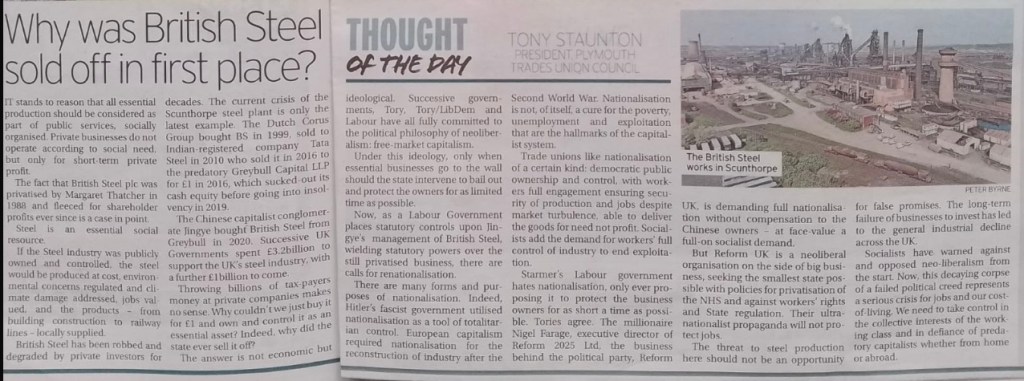
My weekly Comment column in the daily Plymouth Herald (15.4.25), looking at one aspect of the current crisis of British Steel. Of course we want all utilities and public services nationalised, but under what governance exactly? There’s no reason for workers to trust State Capitalism – it simply maintains the competition and exploitation at the very heart of the System. Workers’ control of production will require a revolution.
The full unedited article here:
To eliminate poverty every essential product should be managed not for profit but for human need. Those needs are determined by the daily requirements for survival.
Every human being needs nutritious food, warm and dry shelter, protective clothing, love and nurturing, and education that ensures we learn how to look after ourselves and others. Socialism is the idea of a society that meets those needs for everyone – collective ownership of the means of production.
In a society of 67million human beings our needs have to be produced at scale. So we need mass production of food and housing and wherewithal, which in turn means we need large quantities of nutrients and bricks and materials, including steel for transport and buildings.
It becomes clear that these materials should be regarded as essential, not luxury items that we may also want but not need.
It stands to reason that all essential production should be considered as part of public services, socially organised. Private businesses do not operate according to social need, but rather for short-term private profit.
The fact that British Steel plc was privatised by Thatcher in 1988 and fleeced for shareholder profits ever since is a case in point. Steel is an essential social resource. If the Steel industry was publicly owned and controlled, the steel would be produced at cost, environmental concerns regulated and climate damage addressed, jobs valued, and the products – from building construction to railway lines – locally supplied.
As it is, British Steel has been a cash cow for private investors – shareholders seeking a maximum return on their money – for decades. Along the way they’ve sucked dry the blast-furnaces in Port Talbot and Llanwern, steel making in Teesside and the electric arc furnace in Rotherham.
The current crisis of the Scunthorpe steel plant is the latest example. The Dutch Corus Group bought BS in 1999, sold to Indian-registered company Tata Steel in 2010 who sold it in 2016 to Greybull Capital LLP for £1 in 2016, sucking-out its cash equity before going into insolvency in 2019.
Greybull is one of those predatory capitalist cowboy-firms buying vulnerable companies cheap and sucking them dry at the cost of thousands of jobs and livelihoods, including the Monarch Airline company.
The Chinese capitalist conglomerate Jingye bought British Steel from Greybull in 2020 promising huge investments, wanting a Made-in-Britain badge in the steel it supplies at market rates. The UK Governments pledged £3.2billion to support the UK’s steel industry, with more to come in the next few months.
Surely, throwing billions of tax-payers money at private companies makes no sense. Why couldn’t we just buy it for £1 and own and control it as an essential asset? Indeed, why did the State ever sell it off?
The answer is not economic but ideological. Successive governments, Tory, Tory/LibDem and Labour have all fully committed to the political philosophy of neoliberalism: free-market Capitalism – the opposite of socialism. First sponsored by President Reagan and Margaret Thatcher, the belief is that the neoliberal State should not own anything that can make a profit for a private business.
Under this ideology, only when essential businesses go to the wall should the State intervene to bail out and protect shareholders for as limited time as possible. Hence the creeping privatisation of the NHS, and absurd ups-and-downs of the rail and bus industries, their profits wholly underwritten by our taxes. Socialism always and only for the super-rich, profits guarantee from the common wealth.
Now, as a Labour Government takes over the management of British Steel wielding statutory powers over the still privatised business, there are calls for renationalisation.
There are many forms and purposes of nationalisation. Capitalism required it for the reconstruction of industry after the Second World War. Indeed, Hitler’s fascist government, and Mussolini’s Italian fascist State utilised nationalisation as a tool of totalitarian control. It is not, of itself, a cure for poverty, unemployment, exploitation or oppression.
Trade unions like nationalisation of a certain kind. Democratic public ownership and control, with workers full engagement allows security of production and jobs despite market turbulence, able to deliver the goods for need not profit. Socialists demand workers’ control of industry.
In successive polls, at least 65% of the electorate like the idea of returning our services to public ownership – including water, energy, transport, the NHS and Royal Mail. Nationalism is seen as better than corporate ownership.
Starmer’s Labour government, like Blair’s before him, hates nationalisation, only ever doing so to protect the business owners for as short a time as possible. The Tories, now all-but defunct, agree. The millionaire Nigel Farage, executive director of Reform 2025 Ltd, the business behind the political party, Reform UK, bizarrely demands full nationalisation without compensation to the Chinese owners – at face-value a full-on socialist demand.
Bizarre because Reform UK is a thoroughly neoliberal organisation on the side of big business, seeking the smallest State possible with policies for privatisation of the NHS and against workers’ rights and State regulation. The arch-Nationalist Farage may pretend to be a friend of the working class ahead of the May elections, but there is nothing socialist about Reform UK.
The end of steel production here should not be an opportunity for false promises. The long-term failure of businesses to invest at all amongst the general industrial decline across the UK is a vindication of all of us who have warned against and opposed neo-liberalism from the start. This decaying corpse of a failed political creed represents a serious crisis for jobs and cost-of-living that demands we take control, in the collective interests of the working class not the careless greedy bosses.
 Emotional Climate