
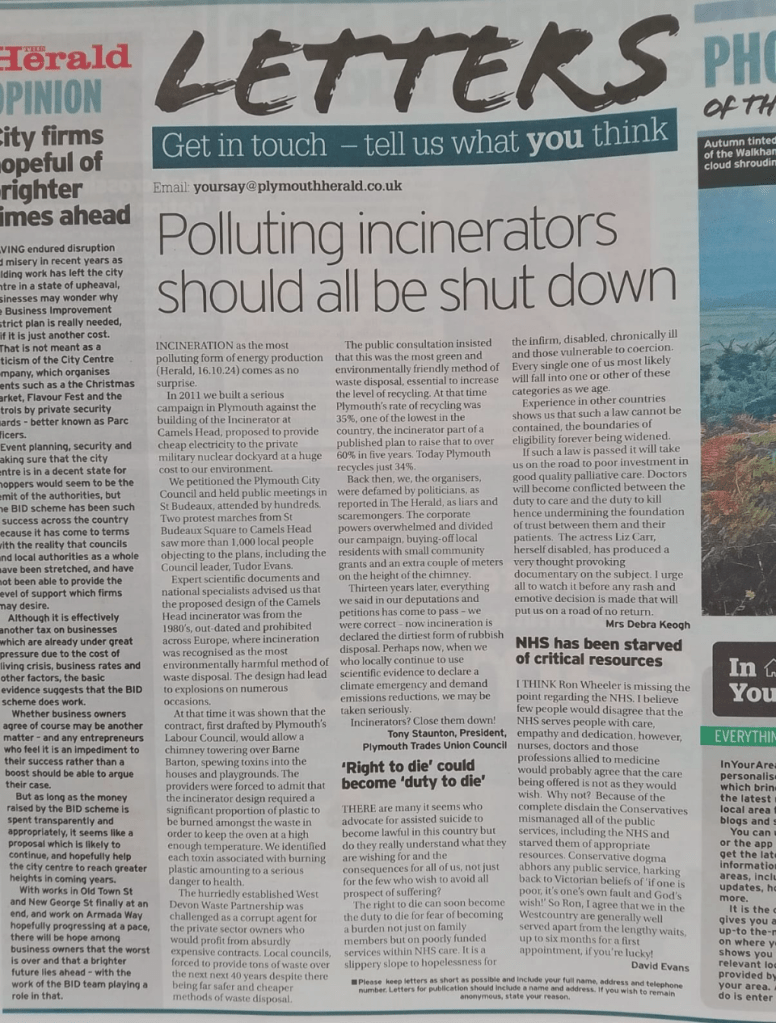
An occasional letter from me to the Plymouth Herald (17.10.24) after an appaling account in the paper detailing how incineration is the dirtiest form of energy production now in the UK. Like we hadn’t told them!
Plymouth’s controversial incinerator has been labelled a ‘disaster for the environment’ as new figures show the amount of waste being brought in from across the county to be burned in the city.
New figures show the Energy from Waste facility in Barne Barton incinerates rubbish trucked in from all over the county, with Devon County Council, Plymouth City Council and Torbay Council all using its furnaces.
A reliance on the incinerator – and others at several other facilities in Devon – mean councils across the county are recycling less of the rubbish they collect, and burning far more.
Research carried out by the BBC’s Shared Data Unit says councils around the country are bound into decades worth of contracts with companies to burn black bag waste – even though some experts now say incineration is a “disaster” for the environment Plymouth and Torbay are among four councils that went from incinerating nothing at all 10 years ago to burning the majority of their waste.
Recycling in Plymouth has decreased around four percentage points to 34 per cent. Back in 2015 Plymouth City Council recycled 38 per cent of its waste, landfilled 62 per cent, and incinerated nothing. By 2023 it was burning 66 per cent of its waste.
Devon, Plymouth and Torbay are all members of the South West Devon Waste Partnership, which has a £436 million contract with MVV Environment, the company that runs the Barne Barton plant.
Devon’s contract with MVV still has 15 years to run, while Plymouth and Torbay are contracted until 2052. The contracts include sharing the income created by selling electricity from the plant, which opened in 2015, to the National Grid.
However, details of that contract are deemed commercially sensitive and are not publicly available. Energy-from-waste companies argue that their methods are far better for the environment than landfill.
The MVV website page on the Barne Barton facility boasts it is a ‘good solution for Plymouth, Devon and Torbay’ and that it is ‘saving resources and reducing the carbon footprint of Plymouth’. But despite stopping waste from going to landfill, the investigation suggests it may not be the green solution it has been sold as.
Instead, they burn millions of tonnes more than a decade ago in large energy from waste facilities – most often situated in the poorest parts of the UK. The incinerators generate electricity for the National Grid, but researchers say they are pumping out greenhouse gases at a rising rate.
They claim the amount of harmful greenhouse gases pumped out of England’s network of 52 major incinerators has increased by 40 per cent in just five years – currently four times the amount predicted by the government. Tonne-for-tonne, the pollution from those sites is on a par with coal in terms of emissions produced.
Bristol-based environment campaigner Dr Dominic Hogg said: “It looks like a disaster because we’ve looked at it too much as though it’s a power generating facility. The reality is this is a way of disposing of waste, and we should treat it as such.
“We should stop considering these things as power stations, because they’re not good examples of power stations. Their principal objective is to get rid and to reduce the volume of waste.”
The Department for the Environment says energy from waste has played an essential role in moving England away from landfill, and emission limits are set well below the level above which harm to the environment or human health could occur. A spokesman for MVV said greenhouse gas emissions from energy-from-waste plants compared favourably to those from landfill.
The spokesman said: “Since 2015, MVV has been treating waste that previously went to landfill – that is waste left over after all efforts have been made to reduce, reuse and/or recycle it. Our activities are regulated by the Environment Agency, including emissions. Maximum emission limits have been reduced in the last year and we operate within them.
“The primary purpose of an energy-from-waste facility is to treat non-recyclable waste. The greenhouse gas emissions should therefore be compared with those from landfill, which are significantly higher and longer-lasting.”
 Emotional Climate