

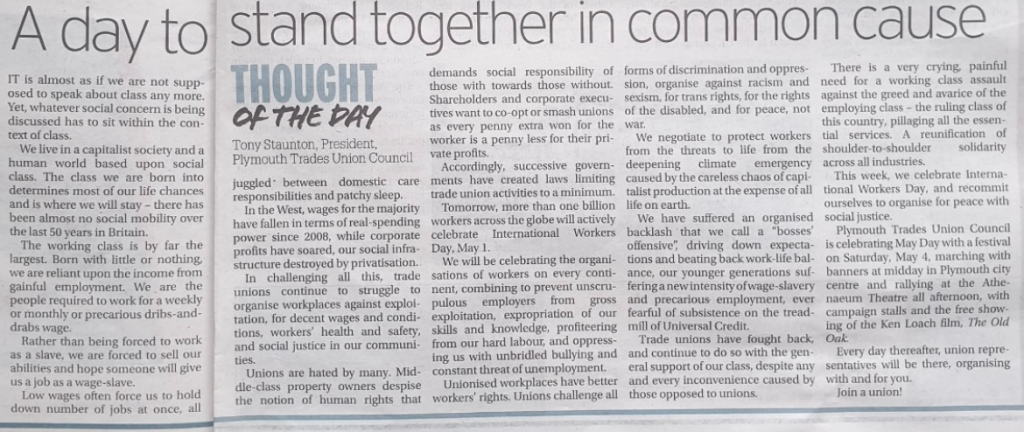
My weekly article for May Day in the daily Plymouth Herald newspaper (30.4.24), identifying the continuing bosses’ offensive against workers, locally and globally. I would like to openly attack and expose the role of the trade union bureaucracy in Britain and across the world, continually protecting Capitalism from open challenge, separating economics from politics in order to curb the anger and action of organised workers. But the column is offered on behalf of the Plymouth TUC, and I therefore fall upon my own sword, a victim of the contradictions inherent in fighting for Peace with Social Justice from inside the System.
It is almost as if we are not supposed to speak about class anymore. Yet, whatever social concern is being discussed has to sit within the context of class.
We live in a society and a human world based upon social class. The class we are born into determines most of our life chances and is where we will stay – there has been almost no social mobility over the last 50 years in Britain.
The working class is by far the largest. More than half the world’s population is now reliant upon the income from gainful employment. We are the people required to work for a weekly or monthly or precarious dribs-and-drabs wage. Rather than being forced to work as a slave, we are forced to sell our abilities and hope someone will give us a job as a wage-slave.
Low wages often force us to hold down number of jobs at once, all juggled between domestic care responsibilities and patchy sleep.
In the West, wages for the majority have fallen in terms of real-spending power since 2008, while corporate profits have soared. In the southern states of the USA, wage rates have fallen so far that Chinese companies are moving businesses there to exploit the working classes now cheaper than Chinese workers at home.
Britain, racing to be the USA’s 51st State is following suit, our social infrastructure betrayed by privatisation is catching-up with the ghetto conditions and collapsed bridges of America.
In challenging all this, trade unions continue to struggle to organise workplaces against exploitation, for decent wages and conditions, workers’ health and safety, and social justice in our communities.
Unions are hated by many. Middle Class property owners despise the notion of human rights that demands responsibilities and liabilities of those with towards those without. Shareholders and corporate executives want to tame or smash unions as every penny extra won for the worker is a penny less for their private profits. And successive governments have created laws limiting trade union activities to a minimum.
Tomorrow, more than one billion workers across the globe will actively celebrate International Workers Day, 1st May.
We will be celebrating the organisations of workers on every continent, combining to prevent unscrupulous employers from gross exploitation, expropriation of our skills and knowledge, profiteering from our hard labour, and oppressing us with unbridled bullying and domination.
Unionised workplaces have better workers’ rights. Unions challenge all forms of discrimination, organise against racism and sexism, for Trans Rights, for the rights of the disabled, and for peace not war.
We negotiate to protect workers from the threats to life from the deepening climate emergency caused by the careless chaos of capitalist production at the expense of all life on earth.
There has been a backlash that we call a “bosses offensive”, driving down expectations and beating back work-life balance, our younger generations suffering a new intensity of “wage-slavery” and precarious employment, ever fearful of subsistence on treadmill of Universal Credit.
Trade unions here have fought back, and continue to do so with the support of the majority of the population, despite any and every inconvenience caused.
There is a very crying, painful need for a working class assault against the greed and avarice of the employing class – the real ruling class of this country, pillaging all the essential services. A reunification of shoulder-to-shoulder solidarity across all industries and nations.
A worker in Britain today has more in common with a worker in Mumbai or Beijing than with any of the politicians in Parliament, the millionaire TV celebrities or the corporate billionaires.
We celebrate International Workers Day, and organise for peace with social justice.
Plymouth Trades Union Council is celebrating May Day with a festival on Saturday 4th May, marching with banners at midday in the city centre and rallying at the Athenaeum Theatre in the afternoon, with campaign stalls and the free showing of the Ken Loach film, “The Old Oak”.
And every day thereafter, union representatives will be there, organising with and for you. Join a Union!
 Emotional Climate