
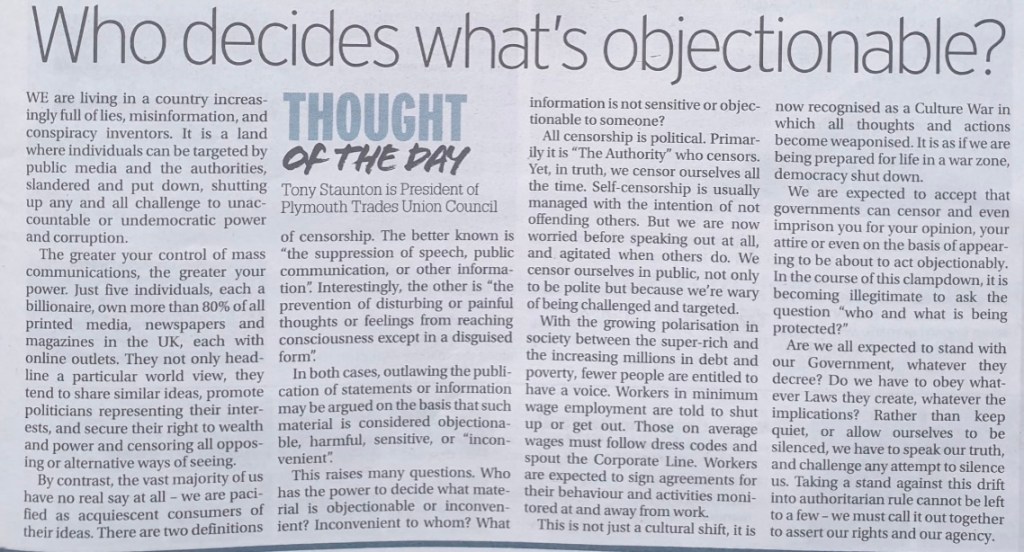
This article, edited, was the follow-up to my column on the War on Gaza that was stopped from being printed on 10th October on the grounds that some readers would find it objectionable. The daily Plymouth Herald printed this as my weekly column the following week, on the 17th, aware of my complaints about their censorship, and, I’m grateful to acknowledge, a number of letters to the paper complaining on my behalf. We really do have to keep challenging authority!
Have your say. We are now in a toxic country of lies, misinformation, and conspiracy-inventors. It is a land where individuals can be targeted by public media and the authorities, slandered and put-down to shut-up any and all challenge to unaccountable or undemocratic power and corruption.
This is not the fault of the internet – the World Wide Web of electronic communications. People produce the propaganda. And whilst our dependency upon “smart” screens appears total, it is not the technology that is smart at all. The ideas behind all the images, text and talk, however enhanced by Artificial Intelligence, come from individuals and groups putting forward a political viewpoint.
The greater your control of mass communications, the greater your power. Just five individuals, each a billionaire, own more than eighty percent of all printed media, newspapers and magazines in the UK, each with online outlets. They not only headline a particular worldview, but as billionaires they tend to share a similar ideologies, blanking out and censoring all opposing or alternative ways of seeing.
By contrast, the vast majority of us have no real say at all – we are passified as acquiescent consumers of the ideas of others. Even our thoughts are censored.
There are two definitions of censorship. The better known is “the suppression of speech, public communication, or other information.” Interestingly, the other is “the prevention of disturbing or painful thoughts or feelings from reaching consciousness except in a disguised form.”
In both cases, the legitimacy of preventing statements or the publication of information may be argued on the basis that such material is considered objectionable, harmful, sensitive, or “inconvenient”.
This raises many questions. Who has the power to decide what material is inconvenient? Inconvenient to whom? What information is not sensitive or objectionable to someone?
Documenting the human world of eight billion individuals, each of us experiencing unique lives in a world of sensations and emotionality, cannot help but arouse disagreement, objection and debate.
On hearing the term, censorship, everyone invokes a sense of the political. Primarily it is “The Authority” who censors. Yet, in truth, each of us censors ourself all the time. Self-censorship is usually managed with the intention of not offending others. We may not say what we really think about how a friend looks, or the choices a family member has made, or the instructions our boss has delivered to us.
We are now wary of speaking out. We censor ourselves in public, not only to be polite but because we’re wary of being challenged and targeted. It’s relatively OK to support a sports club and exchange friendly banter with rival team supporters, but allegiance to a particular political or religious worldview is now supposed to be kept to yourself.
The recognition that we have to be careful what we say, whether we are overheard, what we put into print, creates an inner tension. A push-me-pull-you between ensuring safety and speaking the truth as you see it.
With the growing polarisation in society between rich and poor, fewer people find themselves entitled to have a voice. Workers in minimum wage employment are told to shut up or get out. Those on average wages must follow dress codes and spout the Corporate Line. Professionals in Education, Health and Social Care as well as private businesses must continually prove their allegiance to the mantra and vision of their Agency.
This is not just a cultural shift, it is now recognised as Culture War, all thoughts becoming politically weaponised. It is as if we are being prepared for life in a war zone. Not least, the UK Police Force has now been given discretion and case-by-case judgement as to whether someone is causing upset or may be likely to do so. That matches the description of the Thought Police given by George Orwell in his prescient book, 1984.
We are expected to accept that governments can censor and even imprison you for your opinion, your attire or appearance in the name of security and protection. In the course of this current clampdown it has become illegitimate to ask the question, “whose security and whose protection?”
Allegiance to the Flag and Nation of the country where you currently preside is being weaponised to build hatred and even attack against anyone less enthusiastic. Trade unionists are internationalists, recognising the deep similarities of exploitation and hardship we share with workers across the world, whatever their faith or birthplace. Yet this is being delegitimised despite our movement being many millions strong.
Rather than keep quiet, or allow ourselves to be silenced, we have to speak our truth, and challenge any attempt to silence us. Taking a stand against this drift into authoritarian rule cannot be left to a few – we must all call it out, challenge and combine together to assert our rights and our agency.
Where there is debate and disagreement, cherish it, speak your truth, challenge whatever you feel to be falsehoods, and be prepared to be challenged in return. Or else be prepared to live in far greater fear and distress based in a society organised for the survival of those individuals who are prepared to be the most violent.
 Emotional Climate