

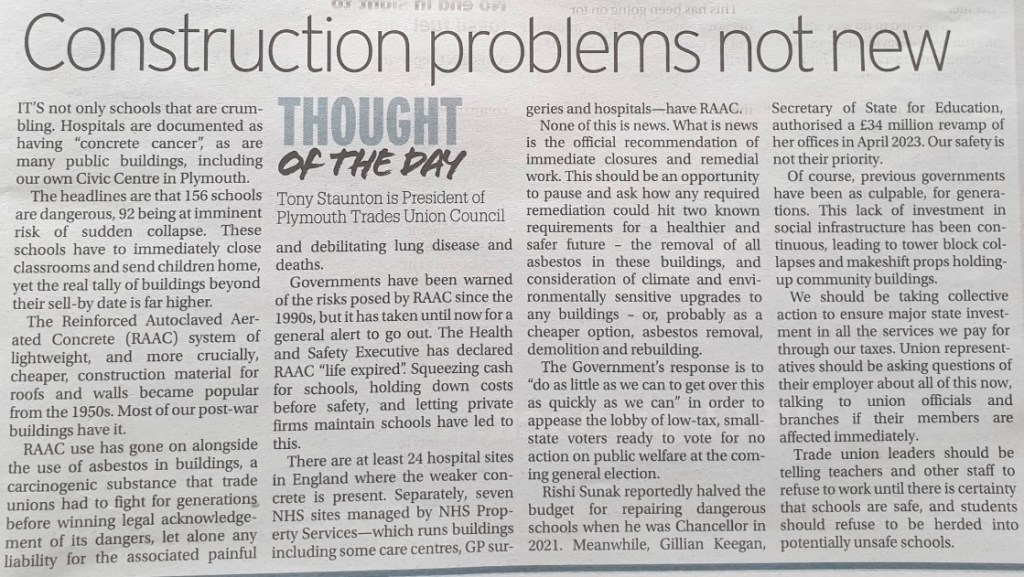
My weekly comment was published in the daily Plymouth Herald newspaper on 6th September 2023. The news of the week was that a number of school buildings had to be shut, and students told to stay at home, just one week before the beginning of the Autumn term. I had wanted to write about the onset of the Neoliberal global politic and economic policies from the early 1970’s and the abject lack of investment in social infrastructure ever since, but I am no economist and the article became an enormous ramble. So I limited my thoughts to the role of health & safety at work today, and what trade union reps should be doing. as always I’m finally interested in promoting working class agency.
It’s not only schools that are crumbling. Hospitals are documented as having “concrete cancer” as are many public buildings, including our own Civic Centre in Plymouth.
The headlines are that 156 schools have to close classrooms and send children home, yet the real toll of buildings beyond their sell-by date is far far higher.
The Reinforced Autoclaved Aerated Concrete (RAAC) system of lightweight, and more crucially, cheaper, construction material for roofs and walls became popular from the 1950’s. Most of our post-war buildings have it.
RAAC use has gone alongside the use of asbestos in buildings, a carcinogenic substance that trade unions had to fight for generations before winning legal acknowledgement of its dangers, let alone any liability for the associated painful and debilitating lung disease and deaths.
Health & Safety activists, members of the Hazards movement and trade unions have reported on the poor state of our schools, hospitals and infra-structure ever since the 70s and 80s. None of this is news.
What is news is the collapse of a beam and the official recommendation of closures and remedial work. This should be an opportunity to pause and ask how any required remediation could hit two known requirements for a healthier and safer future – the removal of all asbestos in these buildings and consideration to climate and environmentally sensitive upgrades to any buildings – or asbestos removal, demolition and re-building green.
The government’s response is to “do as little as we can to get over this as quickly as we can” in order to appease the lobby of low-tax, small State voters ready to vote for no action on public welfare at the coming general election.
It is a matter of public record that Rishi Sunak halved the budget for repairing dangerous schools when he was chancellor in 2021. Meanwhile, Gillian Keegan, Secretary of State for schools, authorised a £34 million revamp of her offices in April 2023.
Our safety is not their priority.
Of course, previous governments have been as culpable, for generations. This lack of investment in social infrastructure has been continuous, leading to tower block collapses and make-shift props holding-up community buildings.
The question of when the next disaster will occur should not be asked. Instead, we should be taking collective action to ensure major State investment in all the services we pay for through our taxes.
Union reps should immediately be asking questions of their employer about all of this now and trying to get the above on the agenda and talking to your union official and branch if their members are affected immediately.
For real action, trade union leaders should be telling teachers and other staff to refuse to work until there is certainty that schools are safe. And students should refuse to be herded into potentially unsafe schools.
 Emotional Climate