

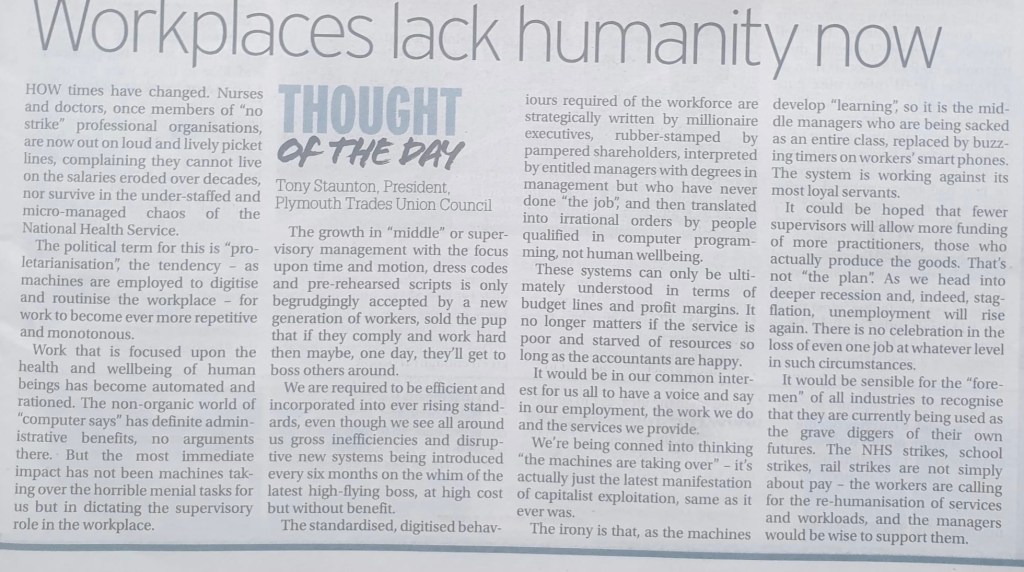
An edited version was printed in the Plymouth Herald on 18.7.23. The unexpurgated version is below:
It is a sad fact that neither the British Medical Association (BMA) nor the Royal College of Nursing (RCN) are affiliated to our Trades Union Congress (TUC), the coalition of most trades unions in Britain. They always chose not to join, stating they were professional organisations and did not do things such as protest or strike.
How times have changed. Nurses and doctors out on loud and lively picket lines, complaining they cannot live on the salaries eroded over decades, nor survive in the under-staffed and micro-managed chaos of the National Health Service. For all the fancy computer hardware analysing our heart-rates and brain connections, it’s the workers who love us and save us.
But “care” is increasingly being prohibited by systems dominated by the need for measurable outcomes, performance management and uniformity.
The political term for this is “proletarianisation”, the tendency, as machines are employed to digitise and routinise the workplace, for work to become ever-more repetitive and monotonous. The “speed-of-the-line”, whatever the job, is speeded-up by middle managers employed solely on constant growth in productivity – increasing the rate of exploitation for the same, or less, cost to the business, whatever it may be. We must forever do more for less.
Work that is focussed upon the health and wellbeing of living human beings has become digitised, automated and rationed. Take, for example, the home care workers, unpaid when traveling between “customers” and required by computer-algorithms to get an elderly infirm person, often isolated and prone to confusion, bed-bathed, up, dressed and breakfasted in a 15 minute slot timed to the second by the “spy-in-the-cab” hand-held computer, pre-programmed to deny any variations from the defined norm of the average person’s needs.
It is dehumanising for both the stressed carer and the uncared-for being processed like a doll on a conveyor belt. It is also not the fault or device of machines. It’s all designed by humans, and always will be. The digital world of “computer says” has definite administrative benefits, no arguments there. But computer programs can’t care and never will. The most immediate impact of Artificial Intelligence, generally wildly over-exaggerated as a replacement human beings, is not in machines doing of the horrible menial tasks for us but in the taking-over of the supervisory role in the workplace.
Supervisory grades were once held in such low-esteem on the “shop-floor” as to produce the adult nursery rhyme, “the working class can kiss my a**e, I’ve got the foreman’s job at last”. A song now long-forgotten in an age of “behaviour management”, it remains very lived as a tension in the workplace.
The growth in “middle” or supervisory management with the focus upon time-and-motion, dress-codes and pre-rehearsed scripts is only begrudgingly accepted by a new generation of workers, sold the pup that if they comply and work hard then maybe, one day, they’ll get to boss others around.
Being told what to do just goes with the job. We all now expect to be efficient and incorporated into ever rising standards, even tho’ we see all around us, gross inefficiencies and new systems being introduced every six-months on the whim of the latest high-flying boss, at high-cost but without benefit. And as customers of these services, whether in the cafe or on the phone, we may be speaking with a human but they sound like a robot.
The standardised, digitised behaviours required of the workforce are written firstly by executives, rubber-stamped by shareholders, interpreted by managers with degrees in management but who have never done “the job”, and then translated into orders by people qualified in computer programming, not human well-being.
Indeed all services are being dehumanised, the farewell “have a nice day” being a required patter, not meant to be meant.
Most of us have experienced a point in time in the workplace where we’ve said, with unassuming self-assurance, that we could do the work much better if left alone and not micro-managed. Instructions passed-down tend not to make sense or even work properly in practice. When can it ever be correct to have to ask and have it authorised before going to the loo? These systems can only be ultimately understood in terms of budget-lines and profit-margins. It no longer matters if the service is poor and starved of resources so long as the accountants are happy.
This is certainly the case in the NHS, swathes of qualified staff resigning out of fatigue and frustration, micro-managed close to death. It appears to be also true in education where the national curriculum syllabus is timed to the moment without any recognition that children learn at different rates. The purpose, surely, is for our children are socialised into acquiescence within “The System”.
It’s everywhere. Even inside the trade unions – undoubtedly the most collective and democratic of all businesses – the decently paid employees, our own “organisers” or “officer class” are required to tow the Party line, to convey corporate logo and loyalty, and keep the membership manageable. Heaven forfend should the union members actually take-over and enact the policy and procedures and organise together, independent of the bureaucracy.
Trade union appointed bureaucrats are distant, separated, politically constrained and the official supervisors of members thoughts and actions. There are classes even inside the working class. Layers of groups with differing levels of power and status, ultimately working against their common interests.
The common interest should be for us all to have a voice and say in our employment and the work we do. The petit-rules fine-printed to prevent any possible challenge to “the Programme” are at an all time high. We’re being conned into thinking “the machines are taking-over” – it’s actually just the latest manifestation of Capitalist exploitation, same as it ever was.
The irony is that, as the machines develop artificial intelligence, so it is the middle managers who are being sacked as an entire class, replaced by buzzing timers on workers’ smart phones. The system is working against its most loyal servants.
It could be hoped that fewer supervisors will allow more funding of more practitioners, those who actually produce. That’s not The Plan. As we head into deeper recession and indeed, stagflation, unemployment will rise again. There is no celebration in the loss of even one job at whatever level in such circumstances.
But it would be sensible for the “foremen” of all industries to recognise that they’re currently being used as the gravediggers of their own futures. The NHS strikes, school strikes, rail strikes are not simply about pay – the workers are calling for the re-humanisation of the services and the workload. And the management would be wise to support them.
Postscript:
As an aside, yet even more important to consider, the global shift to electronics is wholly unsustainable, unaffordable and time-limited. The deepening climate crisis requires, as a priority amongst many requirements, the lowering of energy use. All the precious metals in the world cannot resource the amount of super-conductors, microchips and circuitry required for a digitised economy. The energy required for aircraft hanger-sized processing hubs cannot be maintained in the immediate period, let alone an infrastructure where we can immediately cut global warming emissions to zero to prevent societal collapse in time. The digital economy will have to be rethought if we are to halve our energy use.
We will soon need to return to reliance upon human activities and prioritise production for human need. That could offer us the opportunity to restructure employment and to re-establish workers rights and workplace democracy. All efforts directed towards survival not spreadsheets, cooperative planning not corporate management.
 Emotional Climate