
This is the full-length version of my weekly column in the Plymouth Herald, published on Tuesday 27th June 2023 as less than the 600 words allowed, the editor taking-out my mention of teachers routinely supporting families with food and money. Such is the state of Britain today.
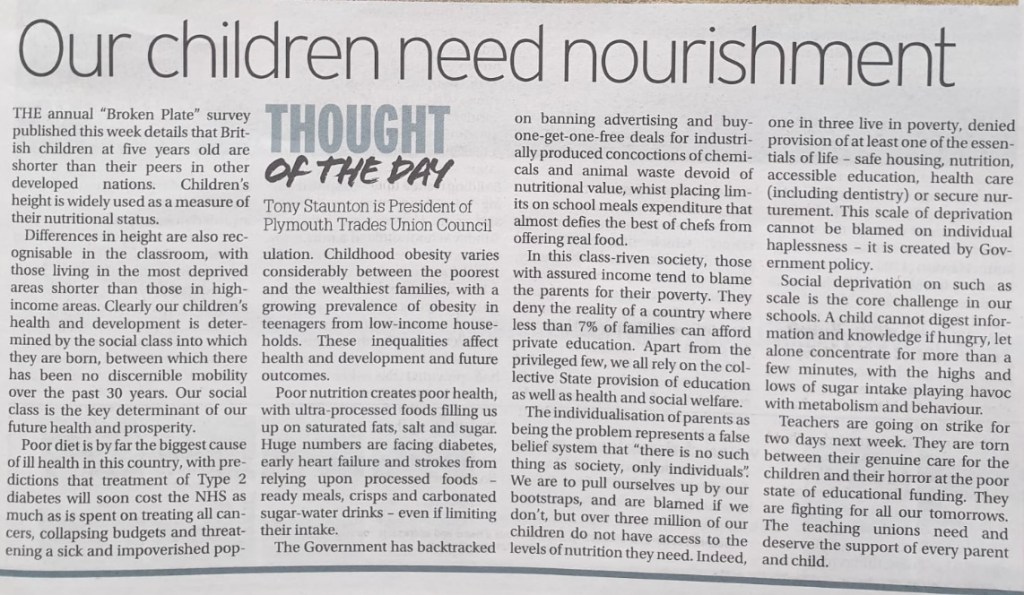
The annual “Broken Plate” survey published this week details that British children at 5 years old are shorter than their peers in other developed nations. Children’s height is widely used as a measure of their nutritional status.
Differences in height are also recognisable in the classroom, those living in the most deprived areas shorter than those in high-income areas. Clearly our society’s health is determined by the social class into which we are born, between which there has been no discernible mobility over the past thirty years. The social class into which we are born is the key determinant of our future health and prosperity.
Poor diet is by-far the biggest cause of ill-health in this country, with predictions that treatment of type-2 diabetes will soon cost the NHS as much as is spent on treating all cancers, collapsing budgets and threatening a sick and impoverished population.
Childhood obesity varies considerably between the poorest and the wealthiest families, with a growing prevalence of obesity in teenagers from low-income households. These inequalities affect health and development and future outcomes.
It is possible to be both obese and undernourished – known as the “invisible hunger”. Conversely it is possible to be of average weight and unhealthy. Poor nutrition creates poor health, with ultra-processed foods filling us up on saturated fats, salt and sugar. Huge numbers are facing diabetes, early heart failure and strokes from relying upon processed foods – ready meals, crisps and carbonated sugar-water drinks – even if limiting their intake.
The government has gone backwards on banning advertising and buy-one-get-one-free deals for industrially produced concoctions of chemicals and animal waste devoid of nutritional value, whist placing limits on school-meals expenditure that almost defies the best of chefs from offering real food.
In this class-riven society, those with assured income tend to blame the parents for their poverty. They deny the reality of a country where less than 7% of families can afford private education. Apart from the privileged few we all rely on the collective State provision of education as well as health and social welfare.
The individualisation of parents as being the problem represents a false belief system that “there is no such thing as society”. We are to pull ourselves up by our bootstraps and blamed if we don’t. It ends with a “survival of the fittest” approach to life; the fascist eugenics movement of selective breeding, letting the poorest perish.
But over 3-million of our children do not have access to the levels of nutrition they need. Indeed, one-in-three live in poverty, denied provision of at least one of the essentials of life – safe housing, nutrition, accessible education, health care (including dentistry) or secure nurturement. This scale of deprivation cannot be blamed on individual haplessness – it is created by government policy.
It is set to get even worse. Prices are continuing to rise due to food shortages caused by climate change. The United Kingdom is reliant of food imports now impacted by unexpectedly poor yields due to extreme weather events – cold winter, heatwaves and floods. There is an under-considered long-term food security challenge.
Internationally there’s an even graver crisis. Last year 12 million children were displaced by climate change. It is estimated that a total of 43.3 million children will be in a condition of forced displacement this year. For most of them, this will be their experience throughout their childhood, and the numbers will increase significant;y in the coming years.
The international crisis is already affecting families here. Food inflation disproportionally affects the poorest fifth of British households, especially those from minority ethnic groups and people living with disabilities. Over 70% percent of the poorest one-fifth of households are reporting cutting back on food and other essential, and prices are not likely to reduce at all whilst wages and benefits are being held stagnant.
Altogether this raises the crucial questions of how we care, and how much we care, for children. We are not yet at the point of guarded conditional love for our own children whilst disliking everyone else’s, but it is the direction of travel. If that is arguable, then just begin with thinking about how much we, individually and as a society, care for children (yes, up to 18 years of age) who are refugees of climate catastrophe or war for dwindling resources.
Social deprivation on such a scale is the core challenge in our schools. So schools are routinely propping-up the diets of a third (or more) of their pupils, teachers often digging into their own pockets to help families. A child cannot digest information and knowledge if they’re hungry, let alone concentrate for more than a few minutes with the highs-and lows of sugar-intake playing havoc with their metabolism and behaviours.
The working class must act collectively in the best interests of our children. Teachers are going on strike for two days next week. They are torn between their genuine care for the children and the deep-felt horror at the poor state of educational funding, the welfare of their pupils as well as their own declining incomes. They are fighting for all our tomorrows, and this fight must be widened and generalised. Right now, the teaching unions need and deserve the support of every parent and child.
Tony Staunton
President, Plymouth Trades Union Council
 Emotional Climate