

Published in Plymouth Herald: Forced into Debt – 22.6.23
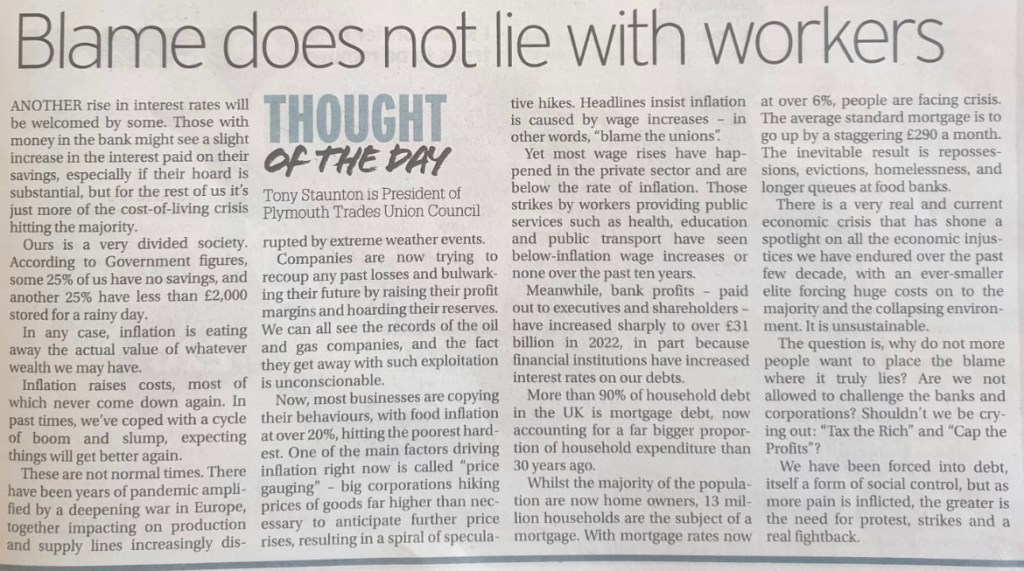
The Bank of England raised UK interest rates to 5% today, after inflation figures stuck at 8.7%CPI in May, the real rate measured by RPI far higher, and food price inflation up to 3 times that rate.
Another rise in interest rates will be welcomed by some. Those with money in the bank might see a slight increase in the interest paid on their savings, especially if their hoard is substantial. But for the rest of us, it’s just more of the cost-of-living crisis hitting the majority. Ours is a very divided society.
According to government figures, some 25% of us have no savings, and another 25% have less than £2,000 stored for a rainy day. In any case, inflation is eating away the actual value of whatever wealth we may have. Inflation raises costs, most of which never come down again.
In past times, we’ve coped with a cycle of boom and slump expecting things will get better again. These are not normal times. There have been years of pandemic amplified by a deepening war in Europe, together impacting on production and supply lines increasingly disrupted by extreme weather events.
Companies are now trying to recoup any past losses and bulwarking their future by raising their profit margins and hoarding their reserves. The UK economy is particularly reliant upon the housing market and the aspiration of home ownership as a tie-in to Capitalist economics and ideology.
There is a crisis developing. We can all see the records of the oil and gas companies, and the fact they get away with such exploitation is unconscionable. Now, most businesses are copying their behaviours, with food inflation at over 20% hitting the poorest hardest.
Profits for FTSE350 firms have shot up by 73% since 2019. One of the main factors driving inflation right now is called “price gauging” – big corporations hiking prices of goods far higher than necessary to anticipate further price rises, resulting in a spiral of speculative hikes.
Headlines from the Bank of England through to mainstream media insists inflation is caused by wage increases – in other words, “blame the unions”. Yet most wage rises have happened in the private sector and are below the rate of inflation. Those strikes by workers providing public services such as health, education and public transport have seen below inflation wage increases or none over the past ten years.
There is a very questionable notion amongst some economists (economics is an art not a science, and subject to a wide spectrum of philosophical commitments) that stopping people spending reduces the demand for goods and therefore slows prices. There is little historical evidence for this. Higher interest rates makes money more expensive, making higher profits for banks.
The profits of the UK banks are jumping sky high. Bank profits – paid out to executives and shareholders – have increased sharply to over £31billion in 2022, in part because financial institutions have increased interest rates on our debts. More than 90 per cent of household debt in the UK is mortgage debt, now accounting for a far bigger proportion of household expenditure than 30 years ago.
Whilst the majority of the population are now “home-owners”, thirteen million households are the subject of a mortgage, a proportion of which are paid by buy-to-let landlords now feeling the pinch and raising charges. Around 5 million of us are renters in this private sector with rents also the subject of price gauging.
With mortgage rates now at over 6%, workers are facing crisis. The average standard mortgage is to go up by a staggering £290 a month. More than 400,000 people will see their existing fixed deals end between July and September. Figures from the Resolution Foundation show the impact of the hikes – already taking a record toll on homes – still has further to run through next year and up to 2026. The inevitable result is repossessions, evictions, homelessness, and longer queues at food banks.
The working class are experiencing a serious cash crisis, best exemplified by the supermarket security tags on butter and baby foods, the mother forced into shop-lifting jailed whilst the profiteers and their political cheerleaders lorded and applauded. The cost of the average weekly shop has increased by over £1,000 a year, whilst Sainsbury’s announced an unexpected £690m in profits, and Tesco, £753m.
There is a very real and current economic crisis that has shone a spotlight on all the economic injustices we have endured over the past few decade, with an ever-smaller elite forcing huge costs onto the majority and the collapsing environment – it’s unsustainable.
There is a tension that belies the facts. The focus upon the very real climate catastrophe and need to Just Stop Oil appears to be placing an impossible demand upon working people. Stop car use, insulate your home, change you diet to sustainable “non-industrialised” foods, use less water, end reliance on fossil fuels… These are either additional and extraneous demands when faced with unpayable bills in the here-and-now, or represent the demands to “tighten our belts” routinely made by politicians and their corporate masters, the focus of dismissal by many.
The future will not be built through individual acts of austerity but mass collective action of a force that can actually challenge those in power.
The question is, why do not more people want to place the blame and responsibility where it truly lies? Are we not allowed to challenge the banks and corporations? Shouldn’t we be crying out: “Tax the Rich!” and “Cap the Profits!”? We have been forced into debt, itself a form of social control. But as more pain is inflicted the greater is the need for protest, strikes and a real fightback.
Tony Staunton
President, Plymouth Trades Union Council
 Emotional Climate