

This article was written and sent into the Plymouth herald one day before the ghastly sinking of a refugee boat off the coast of Greece, drowning hundreds of children, women and men. The outrage and coverage was extremely short-lived, unlike the top-of-the-page coverage of the 5 billionaires stranded on a submersible a week later. Had I waited, I would have asked how billionaires can be worth more than asylum seekers. the question hangs in the air.
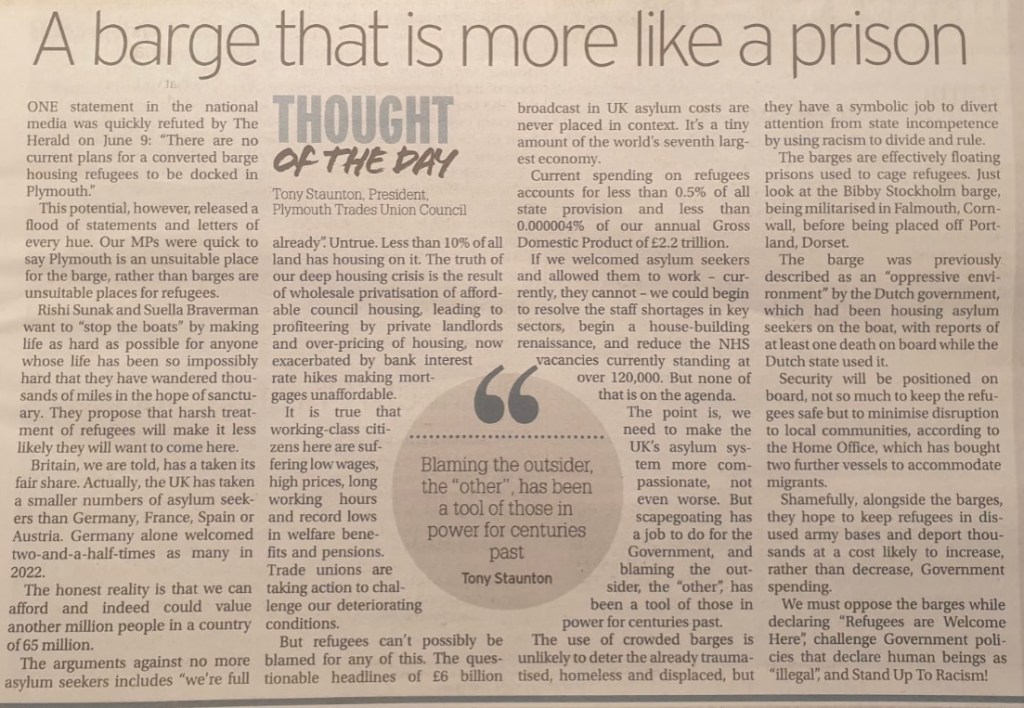
Plymouth herald 12.6.23
“The statement in national media was quickly refuted by the Plymouth Herald (9.6.2023): “There are no current plans for a converted barge housing refugees to be docked in Plymouth.”
This potential, however, released a flood of statements and letters of every hue. Our MPs were quick to say Plymouth is an unsuitable place for the barge, rather than barges are unsuitable places for refugees, only Luke Pollard adding that Plymouth welcomes refugees.
Sunak and Braverman want to “stop the boats” by making life as hard as possible for anyone whose life has been so impossibly hard that they have wandered thousands of miles in the hope of sanctuary. They propose that harsh treatment of refugees will make it less likely they will want to come here.
Britain, we are told, has a proud history of human rights and welcoming those seeking asylum from war, famine and persecution, but with the caveat that they should be of good character, whatever that means. Actually the UK has taken a smaller numbers of asylum seekers, either from Ukraine or other wars in Syria, Sudan, Iraq, Kurdistan and Afghanistan compared with, say, Germany, France, Spain or Austria. Germany took two-and-a-half-times as many in 2022.
The honest reality is that we can afford and indeed could value another million people in a country of 65million.
The arguments against no more asylum seekers includes “we’re full already”. Untrue. Less than 10% of all land has housing on it. The truth of our deep housing crisis is the result of wholesale privatisation of affordable council housing leading to profiteering by private landlords and over-pricing of housing, now exacerbated by bank interest rate hikes making mortgages unaffordable.
It is true that working class citizens here are suffering low wages, high prices, long working hours and record lows in welfare benefits and pensions. Trade unions are taking action to challenge our deteriorating conditions. But refugees can’t possibly be blamed for any of this. There is evidence of profiteering in the price rises of electricity and gas, food and rents, the private businesses seeing others raise their prices and so doing the same, making for record profits.
At the same time, the questionable headline of £6billion broadcast in UK asylum costs are never placed in context. It’s a tiny amount of the world’s seventh largest economy.
The UK spends £231bn in 2022\3 on benefits, £112bn on state pensions, 277bn on health, £27bn on adult social care and £15bn on housing benefits, making refugees account for less than 0.5% of all state provision and less than 0.000004% of our annual Gross Domestic Product of £2.2trillion.
It is also true that the UK economy is in trouble, caused by deregulation of rules for businesses alongside global turbulence caused by the war in Ukraine and extreme weather events.
The question of what to do with refugees will never go away. Climate Change is seeing the displacement of hundreds of millions of people. Huge areas of Central America, Africa, the Far East and China are experiencing large areas no longer able to sustain life, those born there forced by fire, famine or flood to migrate without help or planning. Most of us, if facing the same circumstances, would seek to find shelter in lands less affected. Canada’s fires and the USA’s midwestern drought are affecting millions more. And the UK is currently one of the least affected, whilst countries surrounding the Mediterranean, including France, are experiencing water shortages and crop-destroying heatwave upon heatwave.
There will be, according to the United Nations, one billion refugees seeking sanctuary before 2040. There are solutions. For example, if we welcomed asylum seekers and allowed them to work – currently they cannot – we could begin to resolve the staff shortages in key sectors, begin a house-building renaissance, and reduce the NHS vacancies currently standing at over 120,000. Already, the refugees offered “leave to stay” are contributing more into our economy through work and taxation than they cost to process. Welcoming refugees would boost our economy. But none of that is on the agenda.
The point is, we need to the UK’s asylum system more compassionate, not even worse. But scapegoating has a job to do for the government, and blaming the outsider, the “other” has been a tool of those in power for centuries past. The use of crowded barges is unlikely to deter the already traumatised, homeless and displaced, but they have a symbolic job to divert attention from state incompetence by using racism to divide and rule.
The barges are effectively floating prisons to cage refugees. Just look at the Bibby Stockholm barge being militarised in Falmouth before being placed off Portland, Dorset. The barge was previously described as an “oppressive environment” by the Dutch government, which had been housing asylum seekers on the boat with reports of at least one death on board while the Dutch state used it.
Security will be positioned on board, not so much to keep the refugees safe but to minimise disruption to local communities, according to the Home Office, which has bought two further vessels to accommodate migrants.
Shamefully, alongside the barges the Tories hope to keep refugees in disused army bases and deport thousands at a cost likely to increase rather than decrease government spending.
We must oppose the barges while declaring “Refugees are Welcome Here”, open the borders and challenge government policies that absurdly declare some human beings to be “illegal”. Stand Up To Racism!”
 Emotional Climate